5x114.3 vs 5x115: Why 0.7 mm Makes Them Different
5x114.3 vs 5x115 compared from geometry: the 0.35 mm error at every stud, what it does to a tapered lug seat, and how to tell which pattern you have.
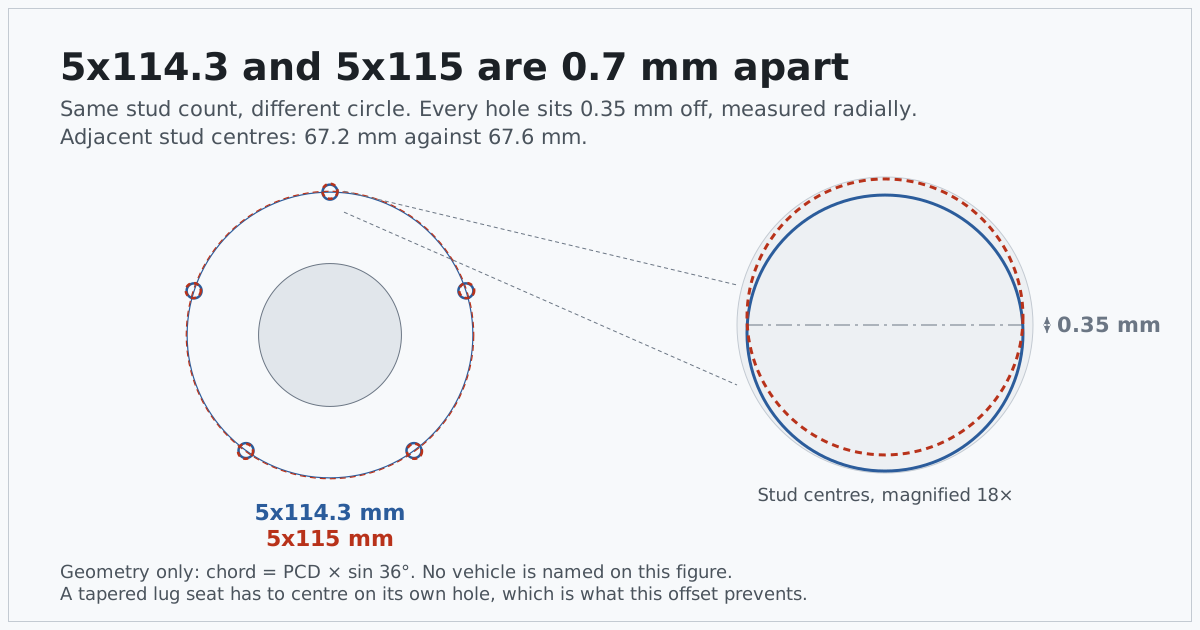
5x114.3 vs 5x115 is the closest near-miss in common wheel fitment, and the gap between them is 0.7 millimetres. That is small enough that the parts will often go together and large enough that they should not. This post works the geometry, shows what the error does at each lug seat, and gives two ways to tell which pattern you are actually holding.
No vehicle is named here. Which cars use which pattern is licensed fitment data, and the point of this post is that you can settle the question with a ruler regardless.
The two patterns, side by side
Both are five studs on a circle. The only difference is the diameter of that circle.
| Property | 5x114.3 | 5x115 | Difference |
|---|---|---|---|
| Pitch circle diameter | 114.30 mm | 115.00 mm | 0.70 mm |
| Pitch circle radius | 57.15 mm | 57.50 mm | 0.35 mm |
| In inches | 4.5000 in | 4.5276 in | 0.0276 in |
| Adjacent stud centres | 67.18 mm | 67.60 mm | 0.41 mm |
| Angle between studs | 72° | 72° | none |
The adjacent-stud figures come from the chord identity, which for a circle of diameter d and n studs gives the straight-line distance between neighbours:
chord = PCD × sin(180° ÷ n) for n = 5, chord = PCD × sin 36° = PCD × 0.5878
So the two patterns differ by 0.70 mm measured across the circle and 0.41 mm measured between neighbouring studs. Note which is larger. The diameter measurement preserves the whole error; the adjacent-stud measurement compresses it to about 59% of itself. If you are trying to detect the difference with a tape measure, measure the diameter.
Where 114.3 comes from
The oddity of the number is a clue to the whole situation. 114.3 mm is 4.5 inches exactly: 4.5 × 25.4 = 114.30. It is an imperial pattern expressed in metric, which is why it has a decimal place when its neighbours do not.
115 mm is simply 115 mm, standardised as a metric figure in its own right.
The two were never designed as alternatives. They are two independent standards that happen to land 0.7 mm apart, and the near-coincidence is an artefact of two unit systems meeting, not a sign that either was meant to accommodate the other. This matters because it tells you there is no tolerance band linking them. Where two patterns are genuinely the same, as with 5x4.5 and 5x114.3, they are the same number written twice. Where they are not, as here, they are separate specifications.
The 0.35 mm, and why it is not nothing
Put the two circles concentric, with one stud of each at the top. Every stud of the 115 pattern sits 0.35 mm further out than the corresponding stud of the 114.3 pattern, measured radially. All five are displaced by the same amount in the same radial direction. There is no rotation you can apply that improves this: rotating one pattern relative to the other only makes things worse, because the patterns are rotationally symmetric at 72° and already aligned.
This is where the intuition usually goes wrong. The number is small compared to the things around it — a stud is many millimetres across, a bolt hole is larger than the stud, a lug nut's seat is several millimetres of contact. Against those, a third of a millimetre sounds like slop that the assembly will absorb.
The assembly will absorb it. That is precisely the problem.
A wheel's bolt holes are drilled larger than the studs that pass through them, because the parts have to go together by hand with normal manufacturing variation. That clearance will usually swallow 0.35 mm, so the wheel goes on. The lug nut, with a conical or spherical seat, then pulls into the matching seat machined in the wheel. There is enough material in that taper to take up a third of a millimetre too, so the nut tightens, the torque wrench clicks, and nothing about the process reports a problem.
What the lug seat is actually for
The conical seat is not simply a way of stopping the nut falling off. As each nut tightens, the taper slides against its seat and pushes the wheel until the cone is concentric with the seat. Done five times in a cross pattern, that is the mechanism that centres the wheel on the hub on a lug-centric design, and that shares the clamping load evenly across the five fasteners on any design.
A 0.35 mm radial error at every hole means every cone contacts its seat off-centre. The nut cannot pull the wheel into alignment, because every seat is asking for the wheel to move in a different direction, and they cancel. What you get is a joint that is clamped but not located as designed, with the contact between each cone and its seat concentrated on one side of the taper rather than distributed around it.
Two consequences follow, and both are about margin rather than immediate failure:
- The joint relies on face friction alone. A properly assembled wheel is held by clamp load at the mounting face, with the seats keeping everything concentric. Remove the concentric seating and the friction is still there, but the geometry that maintains it while bolts settle and bed in is not.
- The contact is uneven. Load concentrated on one flank of each conical seat is a different stress picture from load spread around it, in a part that sees reversed loading every rotation of the wheel.
Neither of those produces a failure on the drive home. That is the difficulty with this mismatch: it fails quietly, in conditions — settled fasteners, heat cycles, a loosening that nobody notices — that arrive long after the person who fitted it concluded it was fine.
This pair is not the only one
5x114.3 and 5x115 are the most discussed near-miss because both are widespread, but the same arithmetic applies wherever two patterns of equal stud count sit close together. The radial error at each stud is always half the difference in pitch circle diameter, and the adjacent-stud difference is always that diameter difference times sin(180° ÷ n).
| Pair | PCD difference | Radial error per stud | Adjacent-stud difference |
|---|---|---|---|
| 5x114.3 and 5x115 | 0.70 mm | 0.35 mm | 0.41 mm |
| 5x120 and 5x120.65 | 0.65 mm | 0.33 mm | 0.38 mm |
| 5x112 and 5x114.3 | 2.30 mm | 1.15 mm | 1.35 mm |
| 5x100 and 5x98 | 2.00 mm | 1.00 mm | 1.18 mm |
| 6x139.7 and 6x135 | 4.70 mm | 2.35 mm | 2.35 mm |
The pattern in that table is worth noticing. The pairs at the top are the dangerous ones, not the pairs at the bottom. A 4.7 mm difference will usually refuse to assemble, or will do so with such obvious misalignment that the person fitting it stops. A 0.65 or 0.70 mm difference assembles cleanly and feels correct, which is exactly the condition under which a mistake gets made and then driven on.
Torque does not tell you the joint is right
One reason the near-miss survives inspection is that the usual check — torquing the fasteners to specification — passes.
A torque wrench measures the twisting effort needed to turn the nut, and that effort is dominated by friction in the threads and at the seat. A nut pulling into an off-centre conical seat still generates friction, so it still produces a torque reading, and the reading arrives at the specified figure in the normal way. What the wrench cannot report is whether the clamp load behind that torque is distributed the way the design assumed, or whether the wheel is concentric with the hub.
The same is true of a re-torque after a few miles, which is good practice and will also pass. A joint assembled on mismatched seats has not failed at that point; it has used up the margin that would normally keep it from failing later.
This is the general shape of the problem with near-miss fitment: every check available to the person doing the work is a check on the assembled state, and the assembled state looks correct. The only check that catches it is the one made before assembly, with a ruler.
Telling them apart with a ruler
Because the mismatch is invisible once assembled, the measurement has to happen first. Five studs cannot be measured straight across, since no stud sits opposite another at 72° spacing. Two methods work, and both are in the bolt pattern guide in more detail.
Offset method, preferred with a tape. Position one stud at the top. Measure from the centre of that stud down to the line joining the centres of the two lowest studs. That distance is the pitch circle diameter: 114.3 or 115. The full 0.7 mm of difference shows up in this reading, which is why it is the better method with ordinary tools.
Chord method, preferred with a calliper. Measure centre to centre between two adjacent studs and divide by 0.5878:
| Measured between adjacent studs | Divided by sin 36° | Pattern |
|---|---|---|
| 67.18 mm | 114.3 mm | 5x114.3 |
| 67.60 mm | 115.0 mm | 5x115 |
Finding the centre of a round stud with a tape is the awkward part of either method. The standard trick: measure from the outside edge of one stud to the inside edge of the other. The two errors are equal and opposite, so the result is centre to centre without any arithmetic. On a wheel rather than a hub, do the same between bolt holes, since the holes are machined on the same circle the studs occupy.
One more check is worth doing when a wheel is already off the car. Rest the wheel on the hub without any fasteners and see whether all five studs sit centred in their holes, or whether every stud favours the same side of its hole. On a matched pattern the studs sit the same way in every hole. On a mismatched one, all five crowd the same edge, inward or outward, because the error is radial and identical at each position. It is a crude test and it depends on the wheel being supported squarely, but the symptom it looks for is exactly the symptom a near-miss produces.
Whichever method you use, take the reading twice from different studs. Machining is consistent; the way a tape sits against a stud is not, and the whole exercise is about detecting less than a millimetre.
If your measurement lands between 114.3 and 115, you have not resolved it. There is no pattern in that gap. Measure again rather than rounding to whichever is closer, because rounding is how the wrong answer gets chosen.
What this does not settle
Getting the bolt circle right is one of several conditions, and the others are independent of it:
- Centre bore. The wheel's bore has to clear the hub register, and if it is larger, a centring ring fills the gap. A ring does nothing about the bolt circle.
- Offset and backspacing. Where the wheel sits across the mounting face governs clearance inboard and outboard. See wheel offset vs backspacing and the wheel offset calculator.
- Fastener thread and seat type. Thread diameter and pitch have to match, the seat shape has to match the wheel's seats, and the length has to give full engagement.
- Load rating. The wheel has to be rated for the axle load, which is on the Tire and Loading Information label on the driver's door edge, where NHTSA directs you for a vehicle's tire and loading figures.
- Tire size. A wheel change often comes with a tire change; the diameter consequences of that are in the tire size calculator.
The answer, stated plainly
5x114.3 vs 5x115 is a difference of 0.70 mm in pitch circle diameter, which is 0.35 mm of radial error at every one of the five studs and 0.41 mm between adjacent stud centres. That error is small enough to pass through the clearance in the bolt holes and be taken up by the taper on the lug seats, which is why the parts can be assembled, and it is large enough that no lug seat in the joint can seat concentrically, which is why they should not be. They are two bolt patterns that happen to be close, not one pattern with a tolerance, and the way to resolve which you have is to measure the pitch circle rather than trust a number you were given.
Sources
- Modern Tire Dealer, Wheel Dimensions (published 2002-01-01) — bolt circle measurement methods, including the offset method for a five-fastener pattern. Retrieved 2026-10-16.
- NHTSA, Tire Safety Ratings and Awareness — the Tire and Loading Information label. Retrieved 2026-10-16.
- All chord, radius and radial-error figures are computed from PCD × sin(180° ÷ n) and PCD ÷ 2; see the methodology page.
Frequently asked questions
Is 5x114.3 vs 5x115 close enough to interchange?
No. The two patterns put every stud 0.35 mm out of position radially. The studs will often pass through the holes because the holes are drilled with clearance, but the tapered lug seats cannot then seat concentrically, so the wheel is clamped without being located the way the design intends. They are two patterns, not one pattern with a tolerance.
How much is 0.7 mm, really?
It is the difference in the diameter of the circle the studs sit on, so it splits into 0.35 mm at each stud. Across adjacent stud centres the difference is 0.41 mm. These are small numbers against a stud diameter, which is the reason the mismatch is not obvious during fitting, and they are large numbers against the concentricity a conical seat needs.
How do I tell 5x114.3 from 5x115?
Measure the pitch circle, not the gap between adjacent studs. Put one stud at the top and measure down to the line joining the two lowest studs: that distance is the PCD. Alternatively measure adjacent stud centres and divide by sin 36 degrees, which is 0.5878. Adjacent centres are 67.18 mm on 5x114.3 and 67.59 mm on 5x115.
Why do both patterns exist if they are so close?
They were standardised separately. 114.3 mm is 4.5 inches exactly, an imperial pattern written in metric; 115 mm is a round metric figure. Neither was designed with the other in mind, and their closeness is a coincidence of unit systems rather than a deliberate near-equivalence.
What about wobble bolts or adapters?
Parts exist that are sold to bridge small PCD differences, and they change the load path through the joint, so whether any of them is appropriate is a question for a qualified fitter looking at the specific vehicle, wheel and part. It is outside what geometry alone can answer, and nothing on this page should be read as endorsing a bridge between these two patterns.
Does a hub-centric ring fix a bolt pattern mismatch?
No. A centring ring fills the gap between a wheel's centre bore and a smaller hub register. It addresses the bore, not the bolt circle, and a 5x114.3 wheel on a 5x115 hub still has every stud 0.35 mm out of position with a ring fitted.