Guides /
Bolt Pattern Guide: How to Measure 4, 5, 6 and 8 Lug
A bolt pattern guide from first principles: what PCD means, how to measure 4-, 5-, 6- and 8-lug hubs, and why a near-match like 5x114.3 is unsafe.
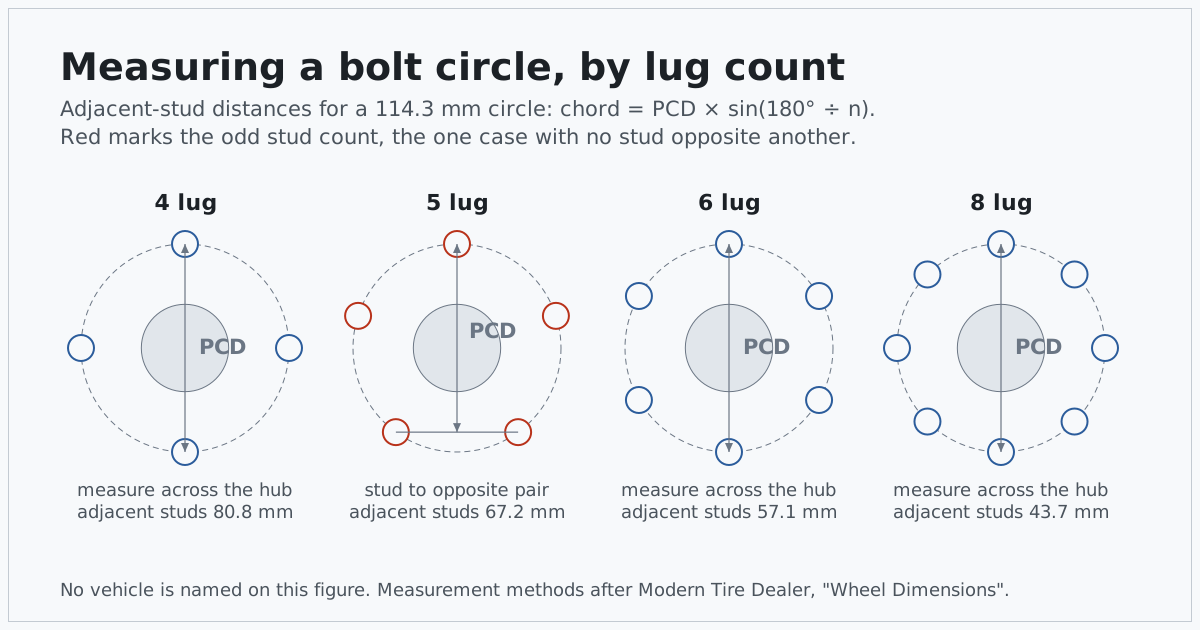
This bolt pattern guide starts from the geometry rather than a lookup table, because the geometry is what tells you whether two patterns are the same, and a lookup table only tells you what someone else typed. By the end you will be able to measure a hub or a wheel with a ruler, work out which pattern you are holding, and see precisely why a near-match is a mismatch.
No vehicle is named anywhere on this page. Publishing which pattern belongs to which car requires a licensed fitment database, and guessing at it is how the wrong wheel ends up on the wrong hub. The method below works on the parts in front of you, which is better than a table anyway.
What a bolt pattern actually is
A bolt pattern is two numbers: how many studs, and the diameter of the circle their centres sit on. Written 5x114.3, it means five studs on a circle 114.3 mm across. That circle is the pitch circle, and its diameter is the PCD.
The studs sit at equal angles around that circle. With n studs the angle between neighbours is 360° ÷ n, which gives the four common cases:
| Stud count | Angle between studs | Studs opposite each other? | Adjacent stud centres on a 114.3 mm circle |
|---|---|---|---|
| 4 | 90° | yes | 80.82 mm |
| 5 | 72° | no | 67.18 mm |
| 6 | 60° | yes | 57.15 mm |
| 8 | 45° | yes | 43.74 mm |
That last column comes from one piece of trigonometry, and it is the only formula in this guide:
distance between adjacent stud centres = PCD × sin(180° ÷ n)
Two studs on a circle of diameter d, separated by angle θ, are d × sin(θ/2) apart in a straight line. With θ = 360°/n that becomes the formula above. It is worth keeping because it gives you a second, independent way to identify a pattern, which matters most on the five-lug hubs where direct measurement is awkward.
Measuring an even stud count: 4, 6 and 8
On 4, 6 and 8 lug patterns every stud has another stud directly opposite it, so the pitch circle diameter is a direct measurement. Put the tape or calliper on the centre of one stud and read the centre of the one across the hub. Modern Tire Dealer's wheel dimensions reference gives exactly this method: for four fasteners, measure from the centre of one hole or stud to the centre of the opposing hole or stud, and for six or eight, measure from the centre of one across the centre of the hub to the centre of the opposing fastener.
Getting the centre of a stud is the fiddly part. Two practical approaches, neither of which needs special tools:
- Measure from the outside edge of one stud to the inside edge of the opposite stud. Those two errors are equal and opposite, so the result is the centre-to-centre distance.
- Measure outside edge to outside edge, then subtract one stud diameter. Same logic, one subtraction.
On a wheel rather than a hub, measure between the bolt holes instead, using the same edge trick. The holes are drilled to the same circle the studs sit on, which is the whole point.
Check the result against the two candidate patterns closest to it. If the answer is somewhere between 4.5 inches and 115 mm, you have not finished measuring. There is no pattern in that gap; there are two patterns on either side of it.
Measuring an odd stud count: the 5-lug case
Five studs at 72° apart means no stud is opposite any other, so there is no straight-across measurement to take. This is the measurement everyone gets wrong, usually by measuring between two adjacent studs and treating that as the PCD. It is not: on a 114.3 mm circle, adjacent studs are only 67.2 mm apart.
Two methods work.
The offset method. Modern Tire Dealer's description is to place one fastener at the 12 o'clock position, then measure to the horizontal line across the bottoms of the two lower fasteners. The distance from the top stud's centre down to that line is the pitch circle diameter. This works because on a five-stud circle the two lowest studs sit symmetrically below the centre, and the line joining them is a chord whose distance from the top stud is exactly the diameter.
The chord method. Measure centre to centre between two adjacent studs, then divide by sin 36°, which is 0.5878:
PCD = adjacent stud distance ÷ sin(36°)
A measured 67.2 mm between adjacent studs gives 114.3 mm. A measured 67.6 mm gives 115 mm. The difference between those two measurements is 0.41 mm, which is at the edge of what a tape measure resolves and well inside what a digital calliper does. If you only have a tape, use the offset method; the 0.7 mm you are trying to detect is magnified into a full 0.7 mm at the diameter rather than compressed into 0.4 mm at the chord.
Both methods benefit from doing the measurement twice from different starting studs. Machining is accurate; your reading of a tape against a round stud is not.
Why a near-match is a mismatch
The reason this bolt pattern guide spends so long on measurement is that the common failure is not a wildly wrong pattern. Nobody tries to put a 4-lug wheel on a 5-lug hub. The failure is a pattern that is almost right.
Take the best-known pair. 5x114.3 and 5x115 differ by 0.7 mm in diameter. Every stud is therefore 0.35 mm out of position, measured radially, because a diameter error splits evenly between the two sides. All five are out by the same amount, in the same direction: outward or inward depending on which way you swap.
Now look at what a lug nut does. On most passenger wheels the fastener has a conical or spherical seat that pulls into a matching seat machined in the wheel. As the nut tightens, that taper slides against the seat and pushes the wheel into position; with five of them tightening in sequence, the wheel is drawn into alignment. The seat is a centring device, not just a clamp.
A 0.35 mm radial error means every cone contacts its seat off-centre. The nut can still be tightened, and it will still feel tight, because the taper has plenty of material to bear on. What it cannot do is seat concentrically. The resulting assembly is clamped but not located the way its designer assumed, and the load path through each seat is uneven. The full version of that argument, with the numbers drawn out, is in 5x114.3 vs 5x115.
It is worth being concrete about why the studs still go through. A wheel's bolt holes are drilled larger than the studs that pass through them, because the assembly has to tolerate ordinary manufacturing variation and still go together by hand. That clearance is what the near-match exploits. With a radial error of a third of a millimetre at each hole, there is usually enough room in the hole for the stud to pass, and the taper of the seat has enough depth to take up the rest. The parts go together, the nuts torque up, and nothing announces that the wheel is sitting on five off-centre cones instead of five concentric ones.
That is also why the mistake survives a test drive. A clamped joint carries load through friction at the mounting face, and a wheel assembled this way still generates friction. What has been given up is the margin: the part of the design that keeps the joint located when the clamp load drops, which is what happens as fasteners settle, as the seats bed in, and as heat cycles the assembly. Those are the conditions under which the error matters, and they arrive later than the fitting does.
The same logic applies to every near pair, and there are several:
| Pattern A | Pattern B | Difference in PCD | Radial error at each stud |
|---|---|---|---|
| 5x114.3 | 5x115 | 0.70 mm | 0.35 mm |
| 5x112 | 5x114.3 | 2.30 mm | 1.15 mm |
| 5x120 | 5x120.65 | 0.65 mm | 0.33 mm |
| 5x100 | 5x98 | 2.00 mm | 1.00 mm |
| 6x139.7 | 6x135 | 4.70 mm | 2.35 mm |
Every one of those is a different pattern. The stud holes in a wheel are drilled larger than the studs, so a surprising number of these combinations will physically go together, which is exactly the problem: the mismatch is invisible once the wheel is on.
Inch and millimetre patterns are the same patterns
A second source of confusion is unit. Some patterns are quoted in inches, some in millimetres, and the inch figures convert exactly:
| Inch notation | Millimetre notation | Conversion |
|---|---|---|
| 5x4.5 | 5x114.3 | 4.5 × 25.4 = 114.30 |
| 5x4.75 | 5x120.65 | 4.75 × 25.4 = 120.65 |
| 6x5.5 | 6x139.7 | 5.5 × 25.4 = 139.70 |
| 8x6.5 | 8x165.1 | 6.5 × 25.4 = 165.10 |
| 4x4 | 4x101.6 | 4 × 25.4 = 101.60 |
5x4.5 and 5x114.3 are not similar patterns, they are the same pattern written twice. Meanwhile 5x114.3 and 5x115 look like the same pattern and are not. The notation actively misleads here, which is why converting everything to millimetres before comparing is a good habit.
What else has to match
A correct bolt pattern is necessary and nowhere near sufficient. Four other things have to be right, and a wheel can have the correct pattern and still be the wrong wheel.
The centre bore. The hole in the middle of the wheel has to clear the hub's register. Many wheels are hub-centric: the bore locates the wheel on the hub and the fasteners clamp it. If the bore is too small the wheel does not go on; if it is larger than the hub, the wheel is located only by the fasteners unless a centring ring fills the gap. Either way the bore is a dimension to check, not to assume.
Offset and backspacing. These decide where the wheel sits across the hub face, and therefore the clearance to the strut inboard and the fender outboard. A wheel with the right pattern and the wrong offset fouls something. The arithmetic is in wheel offset vs backspacing and the conversion is in the wheel offset calculator.
The fastener itself. Thread diameter and pitch have to match the studs, the seat shape has to match the wheel — conical, spherical or flat with a washer — and the length has to give full thread engagement. Mixing seat types is as serious as mixing bolt patterns, and it is easier to do by accident, since the nut will start on the thread regardless.
Load rating. The wheel has to be rated for the axle load, which you read from the Tire and Loading Information label on the driver's door edge, where NHTSA directs you for tire and loading information.
A measuring routine that works
Put together, the routine on an unknown hub or wheel is short:
- Count the studs or holes. That is the first number and it is not ambiguous.
- For an even count, measure centre to centre straight across, using the edge-to-edge trick to find the centres.
- For five studs, use the offset method, or measure adjacent studs and divide by sin 36°.
- Convert to millimetres and compare against the candidate patterns near your result. If your reading sits between two known patterns, measure again rather than picking the closer one.
- Measure the centre bore, and check the offset and the fastener seat before concluding anything about fit.
The geometry here is fixed and checkable: the chord formula in the table at the top of this bolt pattern guide is the same arithmetic the methodology page documents for the whole site, and you can verify any row of it with a calculator in a few seconds. What the geometry cannot do is tell you what your vehicle takes, and anything that offers you that number without a licensed source behind it is guessing on your behalf.
Sources
- Modern Tire Dealer, Wheel Dimensions (published 2002-01-01) — bolt circle measurement methods for 4, 5, 6 and 8 fasteners, and the definitions of rim width, offset and backspacing. Retrieved 2026-10-16.
- NHTSA, Tire Safety Ratings and Awareness — the Tire and Loading Information label as the source for a vehicle's tire and loading figures. Retrieved 2026-10-16.
- Chord and radial-error figures on this page are computed from PCD × sin(180° ÷ n); see the methodology page.
Frequently asked questions
What does a bolt pattern guide mean by 5x114.3?
Five studs, arranged on a circle 114.3 mm in diameter measured through the stud centres. The first number is the stud count, the second is the pitch circle diameter, or PCD. Both must match for a wheel to mount correctly; a wheel with the right stud count and the wrong circle is a different pattern, not a loose fit.
How do I measure a 5-lug bolt pattern?
You cannot measure straight across, because on an odd stud count no stud sits opposite another. Measure from the centre of one stud to the far edge of the hole two positions away, or to the line joining the two studs furthest from it. A 5x114.3 pattern has 67.2 mm between adjacent stud centres, so that chord measurement is a second way to confirm which pattern you have.
Can I use a 5x114.3 wheel on a 5x115 hub?
No. The patterns differ by 0.7 mm in diameter, which puts every stud 0.35 mm out of position radially. The studs may pass through the holes, but each tapered lug seat then contacts its seat off-centre, so the wheel is not centred by the fasteners the way the design assumes. Treat the two as separate patterns.
Is the bolt pattern the only thing that has to match?
No. The centre bore has to accept the hub, the offset has to put the wheel where the suspension and bodywork allow, the stud thread and the lug seat shape have to match the fasteners, and the wheel's load rating has to cover the axle load. A correct bolt pattern on its own does not make a wheel fit.
Why are some patterns in inches and some in millimetres?
Because they were standardised in different places. 4.5 inches and 114.3 mm are the same circle written two ways, since 4.5 × 25.4 = 114.3. A pattern quoted as 5x4.5 and one quoted as 5x114.3 are identical. A pattern quoted as 5x115 is not, even though it looks close.
Can a wheel adapter fix a bolt pattern mismatch?
Adapters exist that present one pattern to the hub and another to the wheel, and they also move the wheel outboard by their own thickness, which changes offset, loads the bearing differently and adds a second set of fasteners to maintain. Whether that is acceptable is a question for a qualified fitter looking at the specific vehicle and part, not something this geometry page can answer.