Guides /
Tire Size Meaning: Every Number and Letter Explained
Tire size meaning, field by field: service type, width, aspect ratio, construction, rim, load index and speed rating, with cited reference tables.
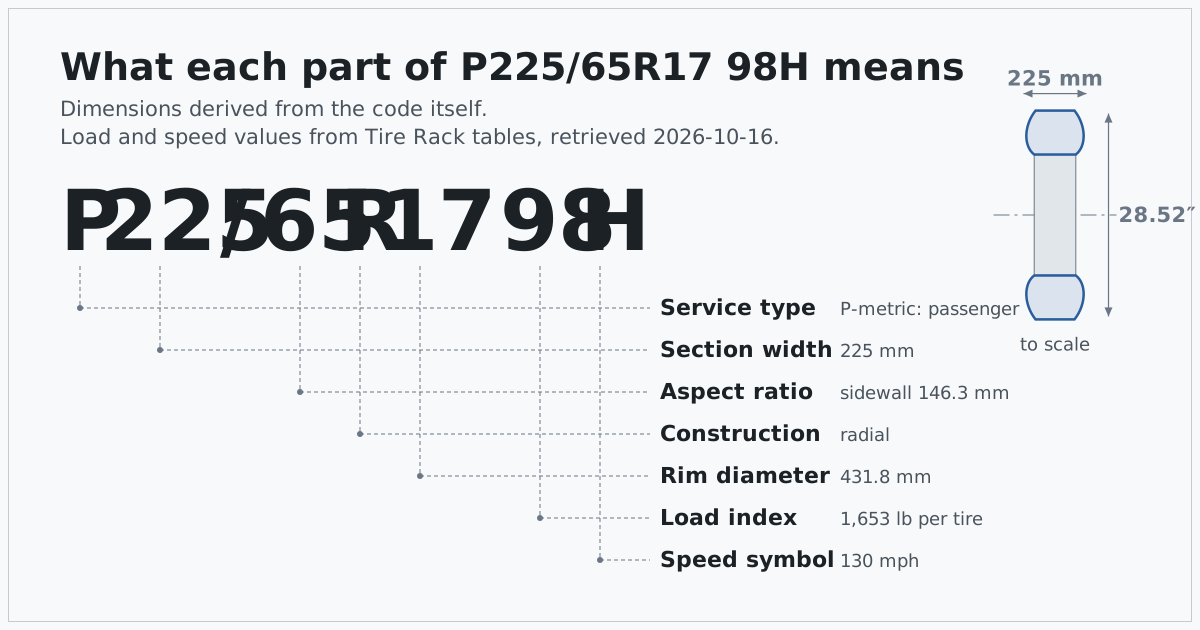
Tire size meaning is mostly hidden in plain sight: the string on your sidewall is a specification, and every character in it is doing a job. This guide takes P225/65R17 98H apart one field at a time, shows the arithmetic each field feeds, and gives the reference tables for the two fields you cannot derive — the load index and the speed symbol.
Nothing here is vehicle-specific. The size code describes the tire, not the car it belongs on. For what your vehicle calls for, the authority is the Tire and Loading Information label on the driver's side door edge or the owner's manual, both of which NHTSA points to.
The whole code at a glance
| Field | Example | What it is | Unit |
|---|---|---|---|
| Service type | P | What class of vehicle the tire is built for | letter code |
| Section width | 225 | Width across the widest part of the tire | millimetres |
| Aspect ratio | 65 | Sidewall height as a percentage of section width | percent |
| Construction | R | Internal construction, radial here | letter code |
| Rim diameter | 17 | Wheel diameter the tire mounts on | inches |
| Load index | 98 | Maximum load per tire, via a published table | index number |
| Speed symbol | H | Rated speed, via a published table | letter code |
The mixed units are not an error, they are history. The width and sidewall are metric, the rim is imperial, and the two halves of the code were standardised at different times in different places. Every calculation below converts at exactly 25.4 mm per inch.
Field one: the service type letter
The letter or letters before the width tell you what the tire was designed to carry. Tire Rack's sidewall size page sets these out:
| P | P-metric: designed for vehicles used mainly as passenger vehicles. | | (none) | Euro-metric size (no service-type letter). | | LT (leading) | Light Truck-metric size, for vehicles that carry heavy cargo or tow large trailers. | | LT (trailing) | Flotation light-truck size, written as diameter x width R rim, e.g. 33x12.50R17LT. | | C (trailing) | Commercial tire for vans or delivery trucks (Euro-metric). | | T | Temporary spare, for short-term use until the flat is repaired or replaced. | | ST | Special Trailer Service size, for trailers only. | | HL | Higher load capacity than an XL tire of the same dimensions; the size also ends with XL. |
The distinction that catches people out most often is the leading LT against the trailing LT. A leading LT, as in LT265/70R17, marks a light-truck metric size. A trailing LT, as in 33x12.50R17LT, marks a flotation size, which is written as overall diameter × section width R rim diameter, all in inches. The two formats describe the same kind of tire in completely different units.
A size with no letter at all is a Euro-metric size. P-metric and Euro-metric sizes with the same numbers are not interchangeable in load terms even though their dimensions match, because the two systems compute load capacity differently. That difference is in the service description, not the dimensions.
Field two and three: section width and aspect ratio
The three-digit number is the section width in millimetres: the distance across the widest part of the inflated tire, sidewall bulge to sidewall bulge. It is not the tread width, which is narrower, and it is not the width at the bead. A 225 is 225 mm across its widest point when mounted on its measuring rim at its measuring pressure.
The two-digit number after the slash is the aspect ratio, which Tire Rack's page describes as the height of the sidewall expressed as a percentage of the section width. This is the single most misread field in the whole code, because it is relative:
sidewall height = section width × aspect ratio ÷ 100
| Size | Section width | Aspect ratio | Sidewall height |
|---|---|---|---|
| 205/65R16 | 205 mm | 65 | 133.3 mm |
| 225/65R17 | 225 mm | 65 | 146.3 mm |
| 265/65R18 | 265 mm | 65 | 172.3 mm |
| 225/45R17 | 225 mm | 45 | 101.3 mm |
| 225/75R17 | 225 mm | 75 | 168.8 mm |
Three tires with an aspect ratio of 65 have sidewalls that differ by 39.0 mm. "Sixty-five series" is not a height. Equally, holding the width at 225 and moving the aspect ratio from 45 to 75 changes the sidewall by 67.5 mm, which is 135.0 mm of overall diameter, because the sidewall counts twice.
That doubling is the key to the whole code. Everything you do to the aspect ratio or the width happens at the top and the bottom of the wheel at once.
Field four: the construction letter
| Code | Meaning |
|---|---|
| R | Radial construction. |
| D | Bias-ply (diagonal) construction. |
| RF | Self-supporting run-flat construction. |
R for radial is what almost every modern passenger tire carries. You will also meet ZR, which appears on some high-performance sizes; it is a radial, and where a service description follows it, the speed symbol in that service description is the one that applies.
Field five: rim diameter
The number after the construction letter is the diameter of the wheel the tire is built to mount on, in inches. It is the one field with no tolerance to it at all: a 17-inch tire goes on a 17-inch wheel, and nothing else. Width has a range of acceptable rim widths; diameter does not.
Half-inch sizes exist, such as 16.5, and they are a different fitment from 16 or 17 despite how close the numbers look. This is the same trap as the bolt pattern near-miss covered in the bolt pattern guide: a number that is nearly right is a different specification, not a tolerance.
Putting the dimensions together
With width, aspect ratio and rim diameter you can compute every dimension of the tire:
overall diameter = rim × 25.4 + 2 × (width × aspect ÷ 100)
circumference = π × overall diameter revolutions per mile = 1,609,344 ÷ circumference
For P225/65R17: sidewall = 225 × 0.65 = 146.25 mm, rim = 17 × 25.4 = 431.8 mm, overall diameter = 724.3 mm or 28.52 inches. The circumference is 2275 mm, and the tire turns 707.3 times in a mile.
The revolutions-per-mile figure is the one that connects the size code to your instrument cluster. A speedometer counts rotations and multiplies by the circumference it was calibrated for, so fitting a tire with a different rolling circumference moves the needle by exactly the ratio of the two diameters. The tire size calculator runs that comparison and prints the error at 30, 45, 60 and 75 mph.
These are nominal dimensions computed from the code. A mounted tire measures slightly differently depending on brand, rim width, pressure and load, which is why no serious figure here carries more than one decimal place.
The service description: load index and speed symbol
After the size comes the service description, which Tire Rack describes as the tire's load index and speed rating together: in 98H, the 98 is the load index and the H is the speed symbol. Unlike the dimensions, these two cannot be derived. They are index numbers that point into published tables.
Load index
The load index gives the maximum load the tire can carry, per tire, at its rated inflation. The table below is reproduced from Tire Rack's load index page, retrieved 2026-10-16. It covers index 70 to 126, which is the range that page prints; outside it, this site shows "not available" rather than extrapolating.
| Index | lb | kg | Index | lb | kg | Index | lb | kg |
|---|---|---|---|---|---|---|---|---|
| 70 | 739 | 335 | 89 | 1279 | 580 | 108 | 2205 | 1000 |
| 71 | 761 | 345 | 90 | 1323 | 600 | 109 | 2271 | 1030 |
| 72 | 783 | 355 | 91 | 1356 | 615 | 110 | 2337 | 1060 |
| 73 | 805 | 365 | 92 | 1389 | 630 | 111 | 2403 | 1090 |
| 74 | 827 | 375 | 93 | 1433 | 650 | 112 | 2469 | 1120 |
| 75 | 853 | 387 | 94 | 1477 | 670 | 113 | 2535 | 1150 |
| 76 | 882 | 400 | 95 | 1521 | 690 | 114 | 2601 | 1180 |
| 77 | 908 | 412 | 96 | 1565 | 710 | 115 | 2679 | 1215 |
| 78 | 937 | 425 | 97 | 1609 | 730 | 116 | 2756 | 1250 |
| 79 | 963 | 437 | 98 | 1653 | 750 | 117 | 2833 | 1285 |
| 80 | 992 | 450 | 99 | 1709 | 775 | 118 | 2910 | 1320 |
| 81 | 1019 | 462 | 100 | 1764 | 800 | 119 | 2998 | 1360 |
| 82 | 1047 | 475 | 101 | 1819 | 825 | 120 | 3086 | 1400 |
| 83 | 1074 | 487 | 102 | 1874 | 850 | 121 | 3197 | 1450 |
| 84 | 1102 | 500 | 103 | 1929 | 875 | 122 | 3307 | 1500 |
| 85 | 1135 | 515 | 104 | 1984 | 900 | 123 | 3417 | 1550 |
| 86 | 1168 | 530 | 105 | 2039 | 925 | 124 | 3527 | 1600 |
| 87 | 1201 | 545 | 106 | 2094 | 950 | 125 | 3638 | 1650 |
| 88 | 1235 | 560 | 107 | 2149 | 975 | 126 | 3748 | 1700 |
Two points matter more than the numbers. First, the index is per tire, so four tires at index 98 carry 4 × 1,653 lb between them — but the figure you must satisfy is the axle load on your vehicle's Tire and Loading Information label, not the gross weight of the vehicle divided by four. Second, the rating applies at the inflation pressure the tire is rated at. An underinflated tire does not carry its rated load, which is the reason NHTSA's tire page says to check the pressure of all tires, including the spare, at least once a month.
Load index is not load range. Load range is a separate letter class, common on light-truck tires, describing the construction and inflation class. A tire carries both, and only the load index converts directly to pounds.
Speed symbol
The speed symbol is a single letter giving the speed the tire is rated for. From Tire Rack's speed rating page, retrieved 2026-10-16:
| Symbol | mph | km/h | Symbol | mph | km/h |
|---|---|---|---|---|---|
| L | 75 | 120 | T | 118 | 190 |
| M | 81 | 130 | U | 124 | 200 |
| N | 87 | 140 | H | 130 | 210 |
| P | 93 | 150 | V | 149 | 240 |
| Q | 99 | 160 | W | 168 | 270 |
| R | 106 | 170 | Y | 186 | 300 |
| S | 112 | 180 |
The letters are not in alphabetical order by speed — H sits between U and V, a leftover from an older scheme — so the table is the only safe way to read them. Tire Rack's page also notes that a Y enclosed in parentheses in a service description, as in 285/35ZR19 (99Y), means the tire's top speed has been tested above 186 mph (300 km/h).
NHTSA's position is worth knowing: in a published interpretation the agency states that speed ratings are not required under the federal motor vehicle safety standards, and that manufacturers are permitted to label additional information on the sidewall including speed rating codes. The symbol is a manufacturer's rating, not a federal grade.
The markings that are not part of the size
Several other things are moulded on the sidewall and are often mistaken for part of the size code.
| Marking | What it is |
|---|---|
| DOT Tire Identification Number | The TIN. NHTSA states the last four digits give the week and year the tire was made. |
| Treadwear, Traction, Temperature | The UTQG grades. NHTSA states these ratings are on the sidewall of every passenger vehicle tire sold in the United States. |
| Max load and max pressure | The tire's own maximum figures, not the pressure to run. The pressure to run is on the vehicle's label. |
| M+S, 3PMSF | Mud and snow marking, and the three-peak mountain snowflake for severe snow service. |
| XL or Extra Load | A higher-load version of the same dimensions. Tire Rack's page notes that HL marks a tire with higher load capacity than an XL tire of equivalent dimensions. |
The one that causes real trouble is max pressure. It is the tire's ceiling, not a recommendation. The pressure your vehicle wants is on the Tire and Loading Information label on the driver's door edge, which is also where NHTSA says to find it.
Reading a size change, not just a size
Once the code is legible, the useful question becomes what happens when it changes. Three moves are possible, and they do different things:
- Width only, 225 to 235 at the same aspect ratio: the section gets wider and, because the sidewall is a percentage of width, the diameter grows too. 225/65R17 to 235/65R17 adds 13.0 mm of diameter, a +1.79% change.
- Aspect ratio only, 65 to 55 at the same width: the sidewall shrinks and the diameter drops by twice that. 225/65R17 to 225/55R17 is -45.0 mm, or -6.21%.
- Rim diameter with a compensating aspect ratio, often called plus-sizing: 225/65R17 to 245/55R18 changes the look and the sidewall while holding diameter close, here +0.33%.
The third pattern is the one worth understanding, because it shows what the code is for. The two sizes are different in almost every field and nearly identical in rolling diameter, which is what the speedometer, the ABS and the final drive care about. The fields that changed — width and sidewall height — are the ones that change clearance, ride and steering feel.
None of this tells you whether a size fits your car. Diameter is only one of the constraints; the others are fender and suspension clearance, the rim width the tire is approved for, and the load index against your axle load. Those belong to your vehicle, and the geometry on this page cannot see it.
Checking your own sidewall
Work left to right. Letters before the number give you the service type. Three digits are the width in millimetres. Two digits after the slash are the aspect ratio, a percentage of that width. A letter is the construction. The next number is the rim in inches. Then the service description: a number for load, a letter for speed. Anything further along the sidewall — DOT code, UTQG grades, max load, max pressure, M+S — is a different marking, not part of the size.
Then compare what is on the car against what the vehicle's label specifies. If those differ, the size on the tire is not authority for anything; the label is. Understanding tire size meaning is what lets you see that the two strings differ in a field that matters, instead of assuming that two codes which look alike are interchangeable.
Sources
- Tire Rack, How Do I Read My Tire Size On My Sidewall? — service type prefixes, section width, aspect ratio, construction, rim diameter and service description. Retrieved 2026-10-16.
- Tire Rack, What Is Load Index? — load index table, 70 to 126. Retrieved 2026-10-16.
- Tire Rack, How Do I Check A Tire's Speed Rating? — speed symbol table and the parenthetical Y note. Retrieved 2026-10-16.
- NHTSA, Tire Safety Ratings and Awareness — Tire and Loading Information label, monthly pressure checks, DOT TIN date code, UTQG grades. Retrieved 2026-10-16.
- All dimensional figures on this page are computed from the size codes shown, using the formulas on the methodology page.
Frequently asked questions
What does the tire size meaning of 225/65R17 work out to?
225 is the section width in millimetres. 65 is the aspect ratio, so the sidewall is 65% of 225, or 146.3 mm. R is radial construction. 17 is the rim diameter in inches, 431.8 mm. The overall diameter is 431.8 + 2 × 146.3 = 724.3 mm, about 28.52 inches.
Is a 65 aspect ratio the same height on every tire?
No. The aspect ratio is a percentage of that tire's own section width, not a fixed height. A 205/65 has a 133.3 mm sidewall and a 265/65 has a 172.3 mm sidewall. Two tires with the same aspect ratio and different widths have different sidewall heights and different overall diameters on the same rim.
What is the difference between load index and load range?
They are different scales. The load index is the two- or three-digit number in the service description, and it maps to a maximum load per tire in a published table: index 98 is 1,653 lb. Load range is a letter such as C, D or E used mainly on light-truck tires to indicate the inflation pressure and construction class. A tire has both, and the load index is the one you compare against the axle load on your vehicle's label.
Does a higher speed rating mean a better tire?
It means the tire has been rated for a higher sustained speed, nothing more. A higher-rated tire usually has a stiffer construction, which can change ride and tread life. NHTSA states that speed ratings are not required under the federal motor vehicle safety standards and that manufacturers are permitted to label them. Match or exceed the rating your vehicle calls for rather than treating the letter as a quality grade.
What does a Y in parentheses mean, as in (99Y)?
Tire Rack's speed rating page states that when the Y-speed rating in a service description is enclosed in parentheses, for example 285/35ZR19 (99Y), the tire's top speed has been tested above 186 mph (300 km/h). The unbracketed Y is listed at 186 mph.
Where do I find the correct tire size for my vehicle?
On the Tire and Loading Information label on the driver's side door edge, or in the owner's manual. NHTSA points to both. The size moulded on the tire currently fitted tells you what is on the car, which is not necessarily what the manufacturer specified.