5x120 vs 5x120.65: Two Bolt Patterns, Not Two Units
5x120 vs 5x120.65 (5x4.75) from geometry: 0.325 mm off at every stud, why the inch and metric labels mislead, and how to measure which one you have.
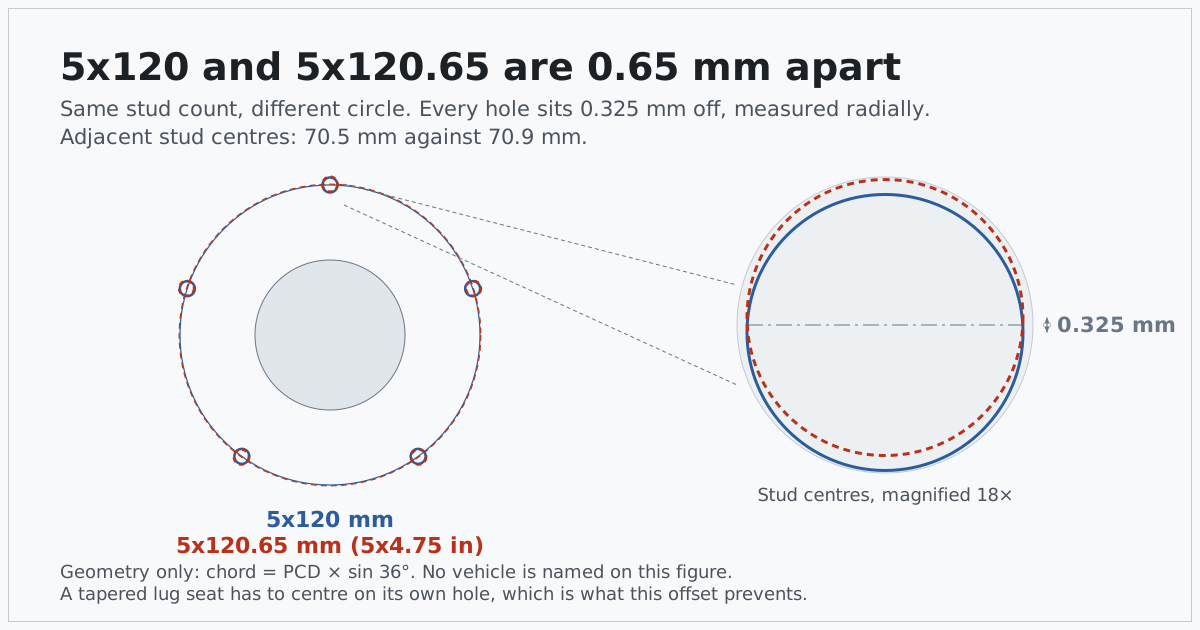
5x120 vs 5x120.65 is a comparison between two bolt patterns that most people assume are one pattern written in two units. They are not. 5x120.65 is 5x4.75 inches converted exactly, and 5x120 is a separate metric pattern that happens to sit 0.65 millimetres smaller in diameter. This post works the arithmetic, shows where the inch and metric labels cause the confusion, and gives a measurement that tells the two apart.
No vehicle is named here. Which cars use which pattern is licensed fitment data, and you don't need it to settle this question. A calliper and the pattern in front of you are enough.
The two patterns in numbers
Both are five studs spaced 72° apart. The only difference is the diameter of the circle the stud centres sit on, the pitch circle diameter or PCD.
| Property | 5x120 | 5x120.65 (5x4.75) | Difference |
|---|---|---|---|
| Pitch circle diameter | 120.00 mm | 120.65 mm | 0.65 mm |
| Pitch circle radius | 60.000 mm | 60.325 mm | 0.325 mm |
| In inches | 4.7244 in | 4.7500 in | 0.0256 in |
| Adjacent stud centres | 70.53 mm | 70.92 mm | 0.38 mm |
| Angle between studs | 72° | 72° | none |
The adjacent-stud row uses the chord identity. For a circle of diameter d with n evenly spaced studs, the straight-line distance between neighbours is:
chord = PCD × sin(180° ÷ n) for n = 5, chord = PCD × sin 36° = PCD × 0.5878
Every figure in the table comes from that identity or from dividing by 25.4. Nothing in it is a measured or quoted value, so you can check all of it with a calculator.
Where 120.65 comes from
The decimal is the clue. A metric pattern chosen as metric gets a round number, and 120.65 is not round. It is what you get when an inch pattern is converted to millimetres:
4.75 in × 25.4 mm/in = 120.65 mm, exactly
The inch was defined as exactly 25.4 millimetres, so this conversion has no rounding in it. 5x4.75 and 5x120.65 are the same pattern written twice. A wheel drilled to one is drilled to the other.
5x120 has no such history. It is 120 mm because 120 is a round metric figure, and converted the other way it comes to 4.7244 inches. If you see 5x120 written as "5x4.72", that is 120 mm rounded to two decimal places of an inch, not an inch standard.
So there are two patterns here, each with more than one name:
| Label you might see | What it is | Circle |
|---|---|---|
| 5x120 | Metric pattern | 120.00 mm |
| 5x4.72 | 5x120 rounded into inches | 120.00 mm |
| 5x4.75 | Inch pattern | 120.65 mm |
| 5x120.65 | 5x4.75 converted exactly | 120.65 mm |
| 5x120.7 | 5x4.75 converted and rounded | 120.65 mm |
The first two rows are one pattern. The last three rows are the other.
Why the labels mislead
The trouble is that the labels group the wrong way. Read quickly, "5x120" and "5x120.65" look like the same pattern with one written more precisely. Meanwhile "5x4.75" and "5x120.65" look unrelated, because one is in inches and one is in millimetres.
The truth is the reverse of what the notation suggests. The two labels that look different are identical, and the two that look nearly identical are different. The same trap shows up elsewhere: 5x4.5 and 5x114.3 are one pattern, while 5x114.3 and 5x115 are two (the 5x114.3 vs 5x115 note covers that pair).
Two habits avoid the trap:
- Convert everything to millimetres before you compare. Multiply an inch figure by 25.4 and keep every decimal. Once both patterns are in the same unit, 120.00 and 120.65 are plainly two numbers.
- Treat a dual label as a question, not an answer. If a listing or a box gives one wheel both labels, "5x120/5x4.75" say, it is naming two circles 0.65 mm apart. The label can't tell you which one the wheel is drilled to, so measure it.
The 0.65 mm is a diameter, not a radius
A common slip in this comparison is to treat the whole 0.65 mm as the error at each stud. It isn't. The PCD is a diameter, so a difference in PCD splits evenly across the two sides of the circle.
Put the two circles concentric with one stud of each at the top. Every 5x120.65 stud sits 0.325 mm further from the centre than the matching 5x120 stud. All five are displaced by the same amount in the same radial direction. You can't rotate the patterns to make it better: they are already aligned at 72°, and any rotation only adds a sideways error on top of the radial one.
Measured between neighbouring studs, the difference is smaller again, at 0.38 mm. That is the diameter difference times 0.5878.
So one mismatch gives three different numbers, depending on where you measure across the pattern. Keeping them apart matters when you go to measure, because comparing a radial figure with a diameter reading would double the apparent error:
| Measured across | Difference between the patterns |
|---|---|
| The full diameter (PCD) | 0.650 mm |
| Adjacent stud centres | 0.382 mm |
| Radially, at each stud | 0.325 mm |
The radial figure is the one that matters at the wheel, because each stud and its lug seat only see their own error. The adjacent-stud figure is the one you will actually measure, because on five studs it is the easiest distance to reach with a calliper.
Closer than the better-known near-miss
5x114.3 vs 5x115 is the near pair people usually cite, at 0.70 mm. 5x120 vs 5x120.65 is closer still. Put through the same arithmetic:
| Pair | PCD difference | Radial error per stud | Adjacent-stud difference |
|---|---|---|---|
| 5x120 and 5x120.65 | 0.65 mm | 0.325 mm | 0.38 mm |
| 5x114.3 and 5x115 | 0.70 mm | 0.350 mm | 0.41 mm |
| 5x112 and 5x114.3 | 2.30 mm | 1.150 mm | 1.35 mm |
On these numbers the smaller gap is the more dangerous one, not the safer one. A 2.3 mm difference will often refuse to go together, or go together so badly that the person fitting it notices. A difference of a third of a millimetre at each stud is small enough to vanish into the clearance of a bolt hole, so the parts assemble and nothing looks wrong.
What a third of a millimetre does at the lug seat
Bolt holes in a wheel are drilled larger than the studs that pass through them, so the parts can go together by hand. That clearance will usually take a 0.325 mm radial error without complaint, so the wheel slides on.
The fasteners are where it matters. On most passenger wheels the lug nut or bolt has a conical or spherical seat that pulls into a matching seat machined in the wheel. As each one tightens, the taper slides against its seat and pushes the wheel until the two are concentric. Done in a cross pattern, that is how a lug-centric wheel is centred and how clamping load is shared evenly across the five fasteners.
With every hole 0.325 mm off, every seat asks the wheel to move in a different direction, and the five requests cancel out. Each fastener tightens against one side of its taper instead of all the way round. The joint ends up clamped but not located the way its designer assumed, with contact concentrated on one flank of each seat.
The 5x114.3 vs 5x115 note works through that argument in full, including why a torque wrench still clicks at the normal figure. Since the radial error here is slightly smaller, the conclusion carries over unchanged: the margin is gone, and nothing during assembly tells you so.
Telling them apart with a calliper
Because the error can't be seen once the wheel is on, the check has to happen before assembly. Five studs can't be measured straight across, since no stud sits opposite another. The reliable method is the chord method from the bolt pattern guide:
- Measure centre to centre between two adjacent studs on the hub, or two adjacent bolt holes on the wheel.
- Divide the reading by 0.5878, which is sin 36°.
- Compare the result with 120.00 and 120.65.
PCD = adjacent stud distance ÷ sin(36°) = adjacent stud distance ÷ 0.5878
| Measured between adjacent studs | Divided by 0.5878 | Pattern |
|---|---|---|
| 70.53 mm | 120.00 mm | 5x120 |
| 70.92 mm | 120.65 mm | 5x120.65 (5x4.75) |
The two readings you're trying to separate are 0.38 mm apart. That is less than half a millimetre, and a tape marked in whole millimetres can't resolve it reliably. A calliper can. Use one that reads to at least a tenth of a millimetre, and treat the measurement as worth doing only with that kind of tool.
Finding the centre of a round stud is the awkward part. The standard trick is to measure from the outside edge of one stud to the inside edge of its neighbour. Those two edge errors are equal and opposite, so the reading equals the centre-to-centre distance with no arithmetic. On a wheel, do the same between bolt holes, which are machined on the same circle the studs occupy.
A few habits make the reading trustworthy:
- Measure more than one pair. Take the reading on at least two different neighbouring pairs. Machining is consistent, and the way a calliper jaw sits against a stud is not.
- Don't round toward the answer you expect. A result between 120.00 and 120.65 hasn't settled anything, since no pattern lives in that gap. Measure again.
- Check the wheel too, not just the hub. The question is whether the two match each other. A hub you measured as 120 and a wheel whose box says "120" haven't been compared until both are measured.
One rough check is also worth doing when the wheel is off the car. Rest the wheel on the hub with no fasteners and look at where each stud sits in its hole. On a matched pair, the studs sit the same way in every hole. On a mismatched pair, all five crowd the same edge, all inward or all outward, because the error is radial and the same at each position. At a third of a millimetre this is hard to see, so it can raise suspicion but can't clear a wheel. The calliper reading decides.
What matching the bolt circle does not settle
Getting the PCD right is one condition among several, and each of the others is independent of it:
- Centre bore. The wheel's bore has to clear the hub register. If it is larger, a centring ring fills the gap. A ring doesn't touch the bolt circle.
- Offset and backspacing. Where the wheel sits across the mounting face sets the inboard and outboard clearance. See wheel offset vs backspacing and run the numbers in the wheel offset calculator.
- Fastener thread, seat and length. Thread diameter and pitch must match, the seat shape must match the wheel's seats, and the length must give full thread engagement.
- Load rating. The wheel has to be rated for the axle load. Your vehicle's tire and loading figures are on the Tire and Loading Information label on the driver's door edge, which is where NHTSA points owners for them.
- Tire size. A wheel change often comes with a tire change. The tire size calculator shows what a new size does to diameter and the speedometer.
The answer, stated plainly
5x4.75 converts exactly to 5x120.65, and 5x120 is a different pattern. The two circles differ by 0.65 mm in diameter. That puts every one of the five studs 0.325 mm out of position radially and makes adjacent stud centres 0.38 mm different. The error is small enough to pass through bolt-hole clearance, so the parts go together, and large enough that no lug seat in the joint can seat concentrically, so they shouldn't. Measure adjacent stud centres with a calliper and divide by 0.5878 to know for certain which side of 5x120 vs 5x120.65 you are on.
Sources
- NHTSA, Tire Safety Ratings and Awareness: the Tire and Loading Information label. Retrieved 2026-10-16.
- Unit conversions use the exact definition 1 inch = 25.4 mm. Chord, radius and radial-error figures are computed from PCD × sin(180° ÷ n) and PCD ÷ 2; see the methodology page.
Frequently asked questions
Is 5x120 the same as 5x4.75?
No. 5x4.75 is an inch pattern, and 4.75 inches is exactly 120.65 mm, so 5x4.75 is 5x120.65. 5x120 is a separate metric pattern whose circle is 0.65 mm smaller in diameter. The two labels look like one pattern written in two units, but they describe two different circles.
Is 5x4.75 the same as 5x120.65?
Yes, exactly. 4.75 × 25.4 = 120.65, with no rounding involved. 5x4.75, 5x120.65 and the rounded label 5x120.7 all describe the same five-stud circle.
What is 5x120 in inches?
120 mm is 4.7244 inches, so 5x120 is roughly 5x4.72. That inch figure is a rounding of a metric pattern, not an inch standard, and it is not 5x4.75.
How big is the difference at each stud?
The 0.65 mm is a difference in diameter, so it splits evenly: every stud sits 0.325 mm out of position, measured radially. Between adjacent stud centres the difference is 0.38 mm, because the chord between neighbours is the diameter times sin 36°, or 0.5878.
How do I tell 5x120 from 5x120.65?
Measure centre to centre between two adjacent studs or bolt holes with a calliper and divide by 0.5878. A reading of 70.53 mm means 120 mm; 70.92 mm means 120.65 mm. The two readings are 0.38 mm apart, so a tape measure is not precise enough to separate them.
Does a hub-centric ring or an adapter fix the mismatch?
A hub-centric ring fills the gap between a wheel's centre bore and the hub register. It does nothing to the bolt circle, so every stud is still 0.325 mm out of position with a ring fitted. Parts sold to bridge small PCD differences change the load path through the joint, and whether any of them suits a particular vehicle, wheel and part is a question for a qualified fitter, not something geometry can settle.