Guides /
Load Index vs Load Range: Two Different Tire Ratings
Load index vs load range: one is a weight per tire, the other a pressure and construction class. Tables for both, SL and XL, and how to check either.
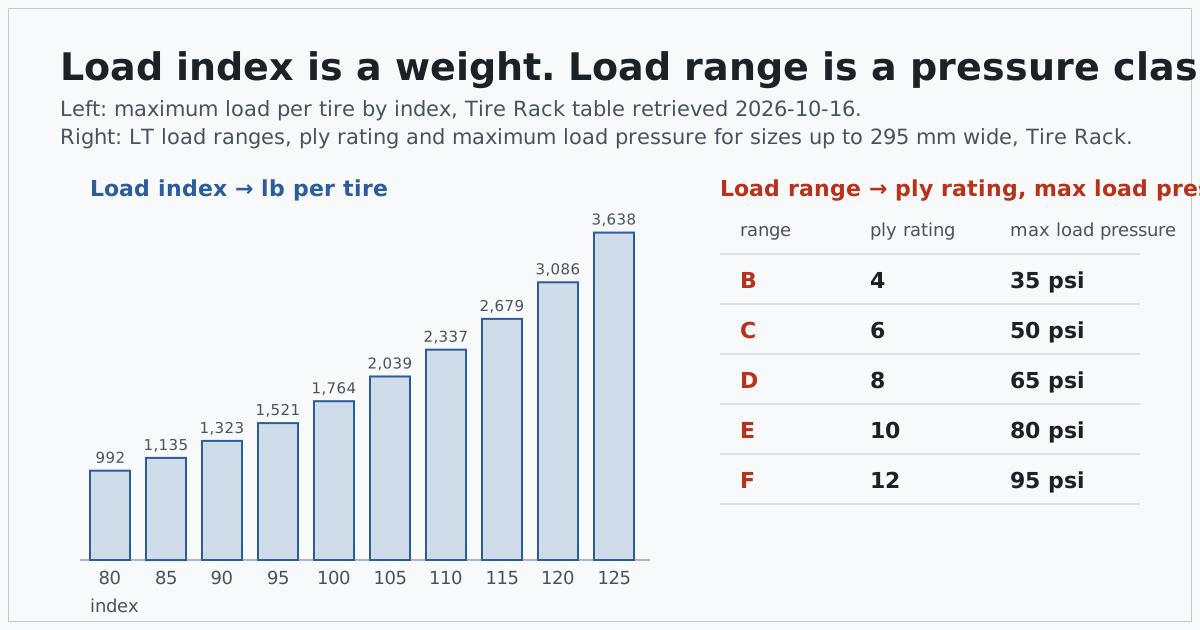
Load index vs load range is a comparison between two ratings that sound alike and measure different things. The load index is a number in the service description that converts, through a published table, into the maximum weight one tire can carry. The load range is a letter, used mostly on light-truck tires, that tells you the tire's construction class and the maximum pressure at which it reaches that weight. A tire can carry both. Only one of them is a weight. This guide sets out each scale, shows how they relate, and explains which one to check against your vehicle.
Nothing here names a vehicle or states what any vehicle needs. That figure is on the vehicle's Tire and Loading Information placard and certification label, which the placard guide explains line by line.
The short version
| Load index | Load range | |
|---|---|---|
| Looks like | A number: 91, 98, 121 | A letter: C, D, E, or SL / XL |
| Where it appears | In the service description after the size, as in 225/65R17 98H | After the size or elsewhere on the sidewall, mostly on LT tires |
| What it tells you | Maximum load per tire, via a table | Construction class and maximum load pressure |
| Converts to pounds? | Yes, directly | No |
| What you compare it to | The load your vehicle puts on each tire | The class the vehicle's original tires carried |
The rest of the page is the detail behind each row.
Load index: a weight, through a table
Tire Rack's load index page defines the load index as an assigned numerical value signifying a tire's maximum load-carrying capacity, with higher numbers meaning more capacity. The number is not a weight itself. It is a key into a table. The table below is the subset of that page's figures stored in this site's reference data, retrieved 2026-10-16:
| Load index | lb per tire | kg per tire |
|---|---|---|
| 85 | 1135 | 515 |
| 88 | 1235 | 560 |
| 91 | 1356 | 615 |
| 94 | 1477 | 670 |
| 95 | 1521 | 690 |
| 98 | 1653 | 750 |
| 100 | 1764 | 800 |
| 102 | 1874 | 850 |
| 104 | 1984 | 900 |
| 107 | 2149 | 975 |
| 110 | 2337 | 1060 |
| 112 | 2469 | 1120 |
| 115 | 2679 | 1215 |
| 116 | 2756 | 1250 |
| 118 | 2910 | 1320 |
| 120 | 3086 | 1400 |
| 121 | 3197 | 1450 |
| 123 | 3417 | 1550 |
| 126 | 3748 | 1700 |
Three properties of the scale are worth knowing.
It is not linear. One step does not add a fixed number of pounds. From 85 to 86 the table adds a little over 30 lb; from 125 to 126 it adds about 110 lb. Each step is roughly a constant percentage, which is why the bars in the header drawing curve upward.
It is per tire. The index is the load on one tire at its rated inflation, not the load on the vehicle. Your vehicle's requirement is set per axle, and the federal standard behind the placard, FMVSS No. 110, defines the vehicle maximum load on the tire as each axle's share of the maximum loaded vehicle weight, divided by two.
It depends on pressure. The rated load applies at the inflation pressure that rating assumes. A tire run below that pressure does not carry its rated load, which is one reason NHTSA's tire safety page asks for all tires, including the spare, to be checked at least once a month when cold.
Tire Rack's page also notes that load indexes come from two standards bodies, the TRA and ETRTO, and that tires from different regions can show slight differences for the same index, mainly on higher-load tires and typically only a pound or two.
Load range: a pressure and construction class
The load range is a separate scale, and on most passenger tires it is barely visible. Tire Rack's load range page describes three classes for P-metric tires:
| Class | Marking | What Tire Rack says it means |
|---|---|---|
| Light load | Not covered by the page | Designed to carry less than standard load; available only in some P-metric sizes at 45 series and lower |
| Standard load | Usually nothing on the sidewall | The default class for P-metric passenger tires |
| Extra load | XL | Built to carry more, at a higher inflation pressure; marked XL in the description |
For light-truck tires, the load range is a letter, and Tire Rack's table ties each letter to a ply rating and a maximum load pressure. The pressure depends on the tire's width:
| Load range | Ply rating | Max load pressure, up to 295 mm / 11.5 in wide | Max load pressure, wider |
|---|---|---|---|
| B | 4 | 35 psi (240 kPa) | not listed |
| C | 6 | 50 psi (350 kPa) | 35 psi (240 kPa) |
| D | 8 | 65 psi (450 kPa) | 50 psi (350 kPa) |
| E | 10 | 80 psi (550 kPa) | 65 psi (450 kPa) |
| F | 12 | 95 psi (650 kPa) | 80 psi (550 kPa) |
Tire Rack's table carries a footnote that matters: select LT sizes are designed with modified maximum load pressures, and the tire's maximum pressure and load as marked on the sidewall must never be exceeded. The table is the general pattern; the sidewall is the authority for a particular tire.
The table applies to LT-metric sizes (LT265/70R17), LT-flotation sizes (33x12.50R17LT) and LT-numeric sizes. The tire size meaning guide explains how to tell those formats apart from a P-metric size.
Ply rating is not a ply count
The second column of the load range table causes more confusion than any other figure on a light-truck sidewall. A "10-ply" tire does not have ten plies. Tire Rack's page states that the ply rating doesn't indicate the actual number of plies used in the tire, and describes it as a rating of equivalent strength to the bias-ply tires of earlier decades.
The scale survives because people still shop by it, and because it lines up one-to-one with the letters: C is 6-ply rated, D is 8-ply rated, E is 10-ply rated. If a listing says "10-ply" and another says "load range E", they are describing the same class. Neither tells you the tire's load in pounds.
How load index and load range fit together
The two scales describe the same tire from different directions. The load index says how much the tire carries. The load range, or SL and XL on a passenger tire, says at what maximum pressure it reaches that load and what construction class it belongs to.
That is why two tires with identical dimensions can carry different load indexes. An SL and an XL version of the same passenger size are dimensionally the same; Tire Rack describes the XL as built to carry more at a higher inflation pressure. Between LT load ranges the same logic applies to the maximum load pressure in the table above. Do not infer the index from the letter, though: read the load index, or the maximum load moulded on the sidewall, for the specific tire.
It also explains why you cannot compare across scales. "Load range E" is not a number of pounds, and "load index 121" is not a pressure. Tire Rack's table shows the load index of 121 as 3197 lb; that figure is per tire, and it only holds at the pressure the tire's load range allows.
Where each rating appears on the sidewall
On a passenger tire, the load index is the easy one to find: it is the number in the service description straight after the size, so in 225/65R17 98H the 98 is the load index and the H is the speed symbol. An extra-load tire adds XL, often next to the size or the service description. A standard-load tire usually adds nothing, which is why many drivers have never noticed the scale exists.
On a light-truck tire there is more to read. Tire Rack's load range page says LT-metric, LT-flotation and LT-numeric tires are branded with their load range, as "load range E" or "LRE", or with their ply rating, as "10 ply rated". Some tires also carry two load indexes separated by a slash; the page's example is a Euro-metric commercial 225/75R16C size marked 121/120, where the two figures are the capacities for single and dual applications, dual meaning two tires side by side at one end of an axle. Each figure converts through the load index table. The page lists that 121 at 3,195 lb, two pounds off the 3,197 lb in the table above, a gap of the size its load index page attributes to slight differences between regional standards.
Separately, the sidewall states a maximum load and a maximum pressure in plain units. Those are the tire's own ceilings, and they are the figures Tire Rack's footnote says must never be exceeded. They are not the pressure to run, which is the vehicle maker's figure on the placard.
Which rating to check, and against what
The rule for replacements comes down to two comparisons, and Tire Rack's load range page states the first plainly: the load index of the replacement tire must be the same or greater than the original tire, and the tire must be rated to carry the load of the vehicle.
- Load index against the original. Find the load index on the original tires, or the tire load requirement your vehicle's documentation gives, and make sure the replacement is equal or higher. Look the index up in the table above to see the pounds involved.
- Load range against the original class. If the vehicle came on LT tires of a given load range, a replacement of a lower range is a lower pressure class, which usually means a lower maximum load. If it came on XL passenger tires, a standard-load replacement of the same size will usually carry less.
For trucks, multipurpose vehicles and trailers, FMVSS No. 110 requires that the sum of the maximum load ratings of the tires on an axle be not less than that axle's gross axle weight rating. For passenger cars the standard requires that the vehicle maximum load on the tire not exceed the tire's load rating. Either way, the tire's rating has to cover the vehicle's load, not the other way round.
Worked check: four tires and an axle
Here is the arithmetic that a load index check comes down to, with the vehicle's figures left as placeholders because they belong to the vehicle.
Take two tires of the same dimensions, one with load index 112 and one with load index 116:
| Load index | Per tire | Two tires on one axle | Four tires |
|---|---|---|---|
| 112 | 2469 lb | 4938 lb | 9876 lb |
| 116 | 2756 lb | 5512 lb | 11024 lb |
The "two tires on one axle" column is the one to compare against an axle rating. The four-tire total is less useful than it looks, because axles are rarely loaded equally; a rear axle under a full bed can carry well over half the vehicle's weight. That is why the standard works per axle, and why the placard and certification label give axle-level figures rather than a single number for the vehicle.
Four steps in index, from 112 to 116, add 287 lb per tire here (2756 lb against 2469 lb). That is the scale's percentage behaviour again: the same four steps lower down the table add far fewer pounds.
Load index vs load range when changing size
A size change does not carry the load rating with it. Plus sizing to a lower-profile tire, or moving from an LT size to a passenger size of similar dimensions, can land on a tire whose load index is lower than the original's, even when the diameters match. Modern Tire Dealer's plus-sizing guidance is never to install a tire with lower load and performance ratings than the vehicle manufacturer recommends.
The tire size calculator checks the geometry of a size change: diameter, sidewall, speedometer error. It cannot check load, because the load index is not part of the size code. Use it for the dimensions, then read the load index of the tire you are actually buying against the table above. The plus-sizing guide walks through both checks in order, because load index vs load range is the question that comes up as soon as a size changes.
Sources
- Tire Rack, What Is Load Index? — load index definition and the index-to-load table; TRA and ETRTO regional differences. Table retrieved 2026-10-16; page re-read 2026-10-17.
- Tire Rack, What Are Load Ranges / Ply Ratings? — light, standard and extra load classes; LT load range table with ply rating and maximum load pressure; ply rating is not a ply count; replacement load index rule. Retrieved 2026-10-17.
- Cornell LII, 49 CFR 571.110 (FMVSS No. 110) — definition of vehicle maximum load on the tire; load rating requirements for passenger cars and for trucks, MPVs and trailers. Retrieved 2026-10-17.
- NHTSA, Tire Safety Ratings and Awareness — monthly cold pressure checks, including the spare. Retrieved 2026-10-17.
- Modern Tire Dealer, The ABCs of Plus Sizing — never fit lower load and performance ratings than recommended. Retrieved 2026-10-17.
- Per-axle and four-tire totals are arithmetic on the table values; see the methodology page.
Frequently asked questions
Is load range the same as load index?
No. The load index is a number, such as 98 or 121, that converts through a published table to a maximum load per tire: 98 is 1,653 lb and 121 is 3,197 lb. The load range is a letter, such as C, D or E, that marks a light-truck tire's construction and the maximum pressure at which it reaches its rated load. A tire can carry both, and only the load index converts directly to pounds.
What does load range E mean?
On an LT-metric, LT-flotation or LT-numeric tire, Tire Rack's table gives load range E a 10-ply rating and a maximum load pressure of 80 psi for sizes up to 295 mm (11.5 inches) wide, and 65 psi for wider sizes. It does not say how much the tire carries; that is the load index or the maximum load moulded on the sidewall.
Does a 10-ply rated tire have 10 plies?
No. Tire Rack's load range page states that the ply rating no longer indicates the actual number of plies in the tire. It is a rating of equivalent strength, carried over from the bias-ply tires the scale was originally written for.
What is the difference between SL and XL tires?
SL is standard load, the default for P-metric passenger tires, which usually carry no load marking at all. XL is extra load: the same dimensions built to carry more at a higher inflation pressure, marked XL in the description. Tire Rack also describes a light load class for some P-metric sizes at 45 series and below, designed to carry less than standard load.
Can I replace an LT tire with a P-metric tire of the same size?
Not by size alone. The two systems rate load differently, and an LT tire's load range often goes with a load index and inflation pressure that a passenger tire of similar dimensions cannot match. Tire Rack's advice is that the replacement's load index must be the same or greater than the original tire and rated to carry the vehicle's load. Check the vehicle's placard and certification label before changing tire type.