Guides /
Hub-Centric Rings and Center Bore, Explained
Hub-centric rings fill the gap between a wheel's center bore and the hub: what they do and do not do, how to size and measure one, and lug-centric wheels.
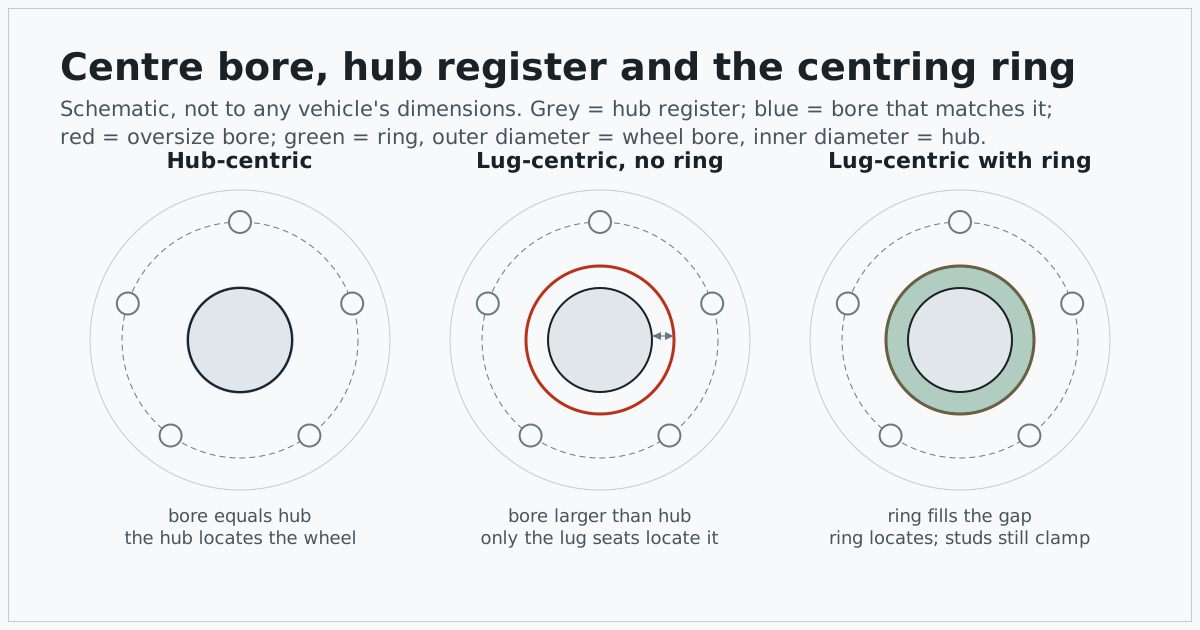
Hub-centric rings are plastic or aluminium spacers that fill the gap between a wheel's center bore and the vehicle's hub, so the wheel is centred by the hub rather than by its fasteners alone. They matter on aftermarket wheels, which are usually made with a bore larger than any one hub so they can fit many vehicles. This guide explains the difference between hub-centric and lug-centric wheels, what a ring does and does not do, and how to size one from two measurements.
The centre bore, often spelled center bore, is a wheel dimension; the hub register it fits over is a vehicle dimension. This page names no vehicle and states no hub size for any make or model. Those are measured on the car or taken from licensed fitment data, and the method below works on the parts in front of you.
Two ways a wheel can be centred
Every wheel has to be located on the hub before it is clamped, so that its centre of rotation coincides with the axle's. There are two ways to do that, and Discount Tire's hub-centric vs lug-centric page defines both.
| Hub-centric | Lug-centric | |
|---|---|---|
| Centre bore | Matches the hub exactly | Larger than the hub |
| What locates the wheel | The hub register, through the bore | The fastener seats in the lug holes |
| Typical on | Most original-equipment wheels | Most aftermarket wheels |
| Ring needed? | No | Recommended, to make it hub-centred |
A hub-centric wheel is, in Discount Tire's words, centred by the hub. The machined register on the hub, the short raised cylinder at the middle of the mounting face, fits the wheel's bore closely, and the wheel cannot sit anywhere but on centre.
A lug-centric wheel centres on the vehicle using the lug holes. Its bore is deliberately oversized so one wheel design can fit hubs of different diameters, and the fasteners pull it into position as they are tightened.
How a lug-centric wheel finds centre
On a lug-centric wheel the centring is done by the seats: the shaped faces where each lug nut or bolt meets the wheel. Tire Review's lug nut article describes the most common seat as conical, almost always at a 60-degree angle. A cone drawn into a matching cone centres itself, so as the fasteners are tightened, each one pulls its part of the wheel towards the stud centre.
That works, and it is how lug-centric wheels are meant to be installed. Its weakness is that it depends on every fastener being tightened evenly and in the right sequence while the wheel is held square. If one is pulled down first while the wheel is sitting off-centre, the wheel can be clamped slightly off-centre. Because the bore does not touch the hub, nothing corrects it.
That is the job of the ring. Discount Tire's hub ring page says hub rings fill the gap between a lug-centric wheel's bore and the vehicle's hub, and that they help reduce high-speed vibration by ensuring the wheel centres on the hub.
What hub-centric rings do and do not do
Discount Tire's hub rings page is precise on both counts, and it is worth keeping the two lists separate.
What a ring does. It turns an oversized bore into a matched one. With the ring seated on the hub, the wheel's bore sits on the ring and the ring sits on the hub register, so the wheel is centred before any fastener is tightened. The fasteners then clamp a wheel that is already on centre.
What a ring does not do. The page states that rings do not carry vehicle load, change fitment specs, or replace proper lug torque and balancing. Each of those deserves a sentence:
- Load. The wheel is held to the hub by the clamping force of the torqued fasteners pressing the mounting face against the hub face. The ring locates; it does not hold.
- Fitment specs. A ring does not change the bolt pattern, the offset, the fastener seat type or the wheel's load rating. If any of those is wrong, a ring does not make it right.
- Torque and balance. A ring makes centring reliable. It does not excuse an unbalanced wheel or fasteners tightened to the wrong torque.
Sizing a ring: two diameters
A ring is described by two numbers in millimetres, outer diameter by inner diameter. Discount Tire gives the convention: the outer diameter matches the wheel's center bore and the inner diameter matches the vehicle's hub. Its example is a 73–67.1 ring, for a 73.0 mm bore on a 67.1 mm hub.
The ring's wall is half the difference between the two:
ring wall thickness = (wheel bore − hub diameter) ÷ 2
| Wheel bore | Hub diameter | Ring wall | Total gap filled |
|---|---|---|---|
| 73.0 mm | 67.1 mm | 2.95 mm | 5.9 mm |
| 73.0 mm | 72.6 mm | 0.20 mm | 0.4 mm |
| 74.1 mm | 66.6 mm | 3.75 mm | 7.5 mm |
The first row is Discount Tire's example. The other two are illustrative bore and hub pairs chosen to show the range, not the dimensions of any vehicle or wheel. The point of the table is the halving: a wheel with a bore 5.9 mm larger than the hub can sit up to 2.95 mm off centre in any direction before the fasteners pull it in. That is the space the ring removes.
Both numbers have to be right. A ring whose outer diameter is too large will not go into the bore; one whose inner diameter is too small will not go onto the hub. Rings are made in many combinations because wheel bores and hubs both vary, and Discount Tire's advice is to verify both numbers before buying.
Measuring the bore and the hub
Neither figure should be guessed, and neither should be taken from a forum post for "your car". Both can be measured.
The wheel's centre bore. With the wheel off the car, measure the inside diameter of the hole at the back of the wheel, on the face that meets the hub. A vernier or digital calliper with inside jaws is the right tool. Measure across the hole in two or three directions and take the largest reading, because a calliper set slightly off the true diameter reads short. If the wheel maker publishes the bore in its specifications, use that as a cross-check on your reading.
The hub register. With the wheel off, measure the outside diameter of the raised lip at the centre of the hub face, using the outside jaws of the calliper. Clean off rust and debris first, so you measure the register and not what has built up on it.
Record both to a tenth of a millimetre. The difference between them tells you whether you need a ring at all:
| Bore compared with hub | Result |
|---|---|
| Bore smaller than hub | The wheel will not fit. A ring cannot help. |
| Bore equal to hub | Hub-centric on this vehicle. No ring needed. |
| Bore larger than hub | Lug-centric on this vehicle. A ring of bore × hub is recommended. |
Discount Tire's hub-centric page puts the first rule simply: a larger bore can go on a smaller hub, but a smaller bore cannot go on a larger hub.
Plastic or aluminium rings
Discount Tire says both plastic (resin) and aluminium rings work, because neither bears load. It notes that plastic resists corrosion and aluminium is more durable. Since the ring's job is location, the more important questions are the fit, which is the two diameters, and whether the ring seats fully against the hub face so it does not hold the wheel off the mounting surface.
Whatever the material, a ring that is cracked, deformed or does not sit flush has stopped doing its job. Discount Tire also points readers to a store or an appointment if they need help measuring.
Vibration: what rings can and cannot explain
Discount Tire's page links rings to one symptom: high-speed vibration on lug-centric wheels, which rings help reduce by ensuring the wheel centres on the hub. A wheel clamped slightly off-centre runs out of round, and that shows up as a vibration that grows with speed.
But a ring is one possible cause among several, and the page itself lists the others implicitly: balancing and torque are separate jobs that a ring does not replace. A vibration after fitting new wheels has to be traced, not assumed. A ring is a cheap, sensible part on an oversized bore; it is not a diagnosis.
Three parts with "hub-centric" in the name
The word gets attached to three different things, and mixing them up leads to buying the wrong part.
A hub-centric wheel is a wheel whose bore matches the hub it is fitted to. It is a property of a wheel on a particular hub, not of the wheel alone: the same wheel can be hub-centric on one hub and lug-centric on a smaller one.
A hub-centric ring is the subject of this guide: a thin sleeve that sits between an oversized bore and the hub, so the wheel behaves as hub-centric. It adds nothing to the wheel's position across the hub face, because it sits inside the bore rather than behind the mounting face.
A hub-centric spacer or adapter is a different kind of part altogether. It sits between the hub face and the wheel, so it moves the wheel outboard by its own thickness and changes the effective offset; "hub-centric" in its name means it has its own register for the wheel to centre on. The bolt pattern guide explains why that is a question for a qualified fitter looking at the specific vehicle and part.
If the problem is an oversized bore, the part you want is the ring.
Center bore is one check among five
The centre bore is one of the dimensions that has to be right for a wheel to fit, and it is easy to confuse with the others because all of them are in the middle of the wheel. The bolt pattern guide covers the full list; the short version is:
| Check | What it decides | Where it is explained |
|---|---|---|
| Bolt pattern | Whether the studs and holes line up | Bolt pattern guide |
| Centre bore | Whether the wheel goes over the hub, and what centres it | This guide |
| Offset and backspacing | Where the wheel sits across the hub face | Wheel offset vs backspacing |
| Fastener seat and thread | Whether the fasteners clamp the wheel correctly | Wheel and fastener maker |
| Load rating | Whether the wheel carries the axle load | Wheel maker and vehicle label |
A ring answers the second question only. It cannot correct a near-miss bolt pattern: in a 5x114.3 against 5x115 mismatch every stud is still 0.35 mm off its hole with a ring fitted, and the ring cannot move a stud. It does not change offset, so it does not move the wheel inboard or outboard. And Tire Review's article warns that an aftermarket wheel can be drilled for a different seat from the vehicle's original fasteners, giving the example of conical-seat wheels for vehicles that came with ball-seat bolts, so a wheel that needs a different seat needs the right fasteners, not a ring.
A short routine for an aftermarket wheel
- Confirm the bolt pattern matches, by measurement, not by label.
- Measure the hub register and the wheel's centre bore.
- If the bore is larger, buy a ring sized bore × hub, and check it seats fully on the hub.
- Confirm the fastener seat matches the wheel, and use fasteners of the correct thread and length.
- Check the offset puts the wheel where the vehicle allows, using the wheel offset calculator.
- Tighten the fasteners in sequence to the specified torque, and have the wheel balanced.
If the wheels come with a new tire size as well, the tire size calculator checks the diameter change, and the plus-sizing guide covers the load and rim-width rules. For the centre of the wheel, the rule is short: match the bore to the hub, and where the bore is larger, hub-centric rings are how you make it match.
Sources
- Discount Tire, Hub rings — when rings are recommended, OD = wheel bore and ID = hub, the 73–67.1 example, what rings do not do, plastic and aluminium. Retrieved 2026-10-17.
- Discount Tire, Hub-centric vs. lug-centric wheels — definitions, which wheels are typically which, larger bore on smaller hub but not the reverse, vibration. Retrieved 2026-10-17.
- Tire Review, Lug nut safety — conical seats almost always at 60 degrees; seat types differ between wheels. Retrieved 2026-10-17.
- The ring wall and gap figures are arithmetic on the bore and hub values shown; the 0.35 mm stud offset is from the 5x114.3 vs 5x115 note and the methodology page.
Frequently asked questions
Do I need hub-centric rings?
Discount Tire describes them as optional but recommended whenever the wheel's center bore is larger than the vehicle's hub. If the bore matches the hub, as on a hub-centric wheel, no ring is needed. If the bore is smaller than the hub, a ring cannot help: the wheel will not go on.
What size hub-centric ring do I need?
Two numbers, both in millimetres: the outer diameter must match the wheel's center bore and the inner diameter must match the vehicle's hub. Discount Tire's example, 73-67.1, is a ring for a 73.0 mm bore on a 67.1 mm hub. Measure or confirm both before buying; a ring that is a fraction too large will not seat and one that is too small will not centre anything.
Do hub-centric rings carry the weight of the car?
No. Discount Tire states that rings do not carry vehicle load, change fitment specs, or replace proper lug torque and balancing. The ring centres the wheel while the fasteners are tightened; the clamping force of the torqued fasteners holds the wheel to the hub.
Are plastic or aluminium hub rings better?
Both work, according to Discount Tire, because the ring does not bear load. Plastic resists corrosion and aluminium is more durable. The material matters less than the fit: the right outer and inner diameters, and a ring that seats fully on the hub.
Can a hub-centric ring fix a wrong bolt pattern?
No. The ring sits in the centre of the wheel and has nothing to do with where the studs are. If the bolt pattern is wrong, for example 5x114.3 against 5x115, every stud is still off its hole by the same amount with a ring fitted. Bolt pattern and center bore are two separate checks.