Guides /
Plus Sizing Tires: The Rules, Worked From Geometry
Plus sizing tires means a bigger wheel and a shorter sidewall at the same diameter. The rules on diameter, load index, rim width and what changes, worked.
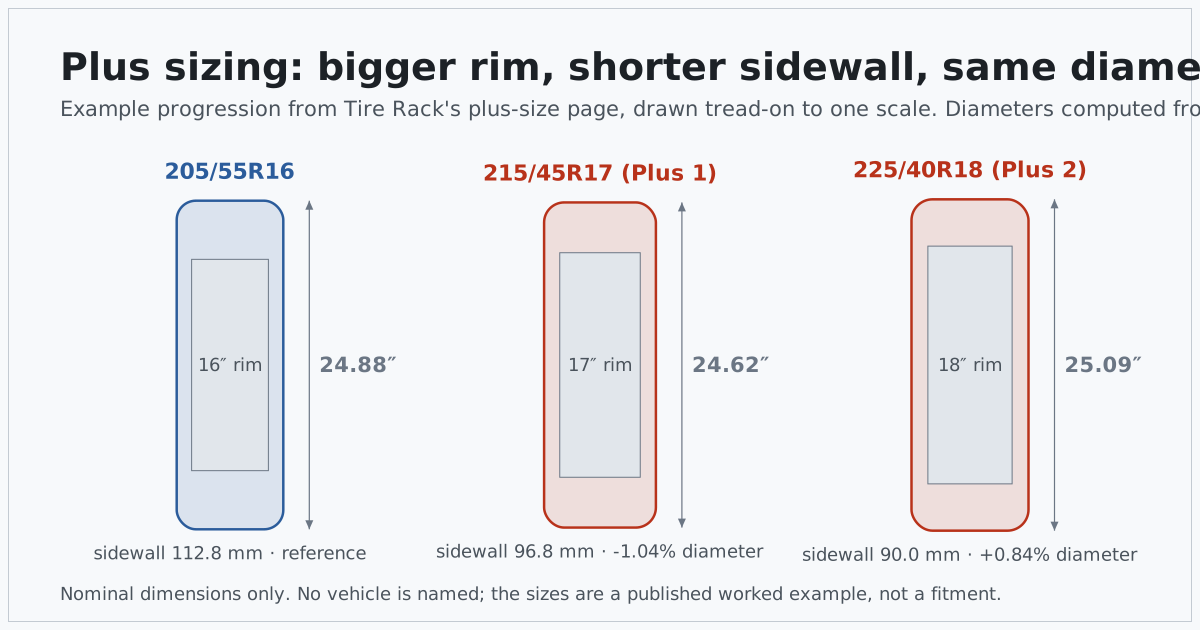
Plus sizing tires means fitting a larger-diameter wheel with a lower-profile tire so the overall diameter stays close to the original. The wheel gets bigger, the sidewall gets shorter, and the outside of the tire ends up in nearly the same place. Done properly, the speedometer, the gearing and the ride height barely move; what changes is the sidewall, the width and how the car feels. This guide sets out the rules, works them through real size codes, and lists the constraints that geometry cannot check for you.
No vehicle is named on this page. Whether a particular wheel and tire clear a particular car is fitment data, and the starting size for your car is the original size on its Tire and Loading Information placard, explained in how to read the tire placard.
What plus sizing is
Tire Rack's plus-size page dates the practice to the 1970s, when Plus One and Plus Two fitments were the available choices, and states the core principle as maintaining the same overall tire diameter. The naming counts inches of wheel diameter added:
| Name | Wheel diameter | What the tire does |
|---|---|---|
| Plus Zero | Unchanged | Wider section, lower aspect ratio |
| Plus One | +1 inch | Lower aspect ratio, usually a little wider |
| Plus Two | +2 inches | Lower again, usually wider again |
| Plus Three | +3 inches | Lower again |
The term "Plus Zero" is trade usage rather than something Tire Rack's page defines, but the arithmetic is identical: hold diameter while changing the width and the aspect ratio.
Tire Rack's page gives a worked progression, which the hero drawing shows to one scale: 205/55R16 on a 16 × 7 inch wheel, then 215/45R17 on 17 × 7, 225/40R18 on 18 × 8, and 235/35R19 on 19 × 9. It also gives the rule of thumb behind that sequence: for each inch of wheel diameter, increase tire width by 10 millimetres and decrease the aspect ratio by 5 to 10 points.
Plus One and Plus Two, worked from the size codes
Here is that same progression with every dimension computed from the codes, using the formulas in the tire size meaning guide.
| Step | Size | Sidewall | Overall diameter | Change from original |
|---|---|---|---|---|
| Original | 205/55R16 | 112.8 mm | 631.9 mm (24.88 in) | none |
| Plus One | 215/45R17 | 96.8 mm | 625.3 mm (24.62 in) | -1.04% |
| Plus Two | 225/40R18 | 90.0 mm | 637.2 mm (25.09 in) | +0.84% |
| Plus Three | 235/35R19 | 82.2 mm | 647.1 mm (25.48 in) | +2.41% |
Over three steps the sidewall loses 30.5 mm, more than a quarter of its height, while each extra inch of wheel adds 25.4 mm of rim diameter. The two nearly cancel. Plus One and Plus Two land within about one percent of the original; the Plus Three step lands at +2.41%, still inside the ±3% convention but noticeably further out. That drift is typical: as sizes get lower, the 5-point aspect ratio steps become coarse relative to the sidewall, and an exact match gets harder to find.
The diameter rule
Every plus-sizing rule follows from the one in the title of Tire Rack's page: keep the overall diameter the same. Modern Tire Dealer's wheel dimensions reference says the same thing in fitment terms, that the overall tire diameter should equal that of the tire originally installed by the car maker, and puts the acceptable band at 2% to 5% of the OEM outer diameter. Its later plus-sizing article, The ABCs of Plus Sizing, narrows that to a variance of 2% to 3% or less as widely accepted, and notes that diameter matters more now because of anti-lock braking, stability control and driver assistance systems.
This site uses ±3% as its flag, and the methodology page labels it as a convention, not a standard. In practice the aim is not "inside 3%" but "as close as the available sizes allow".
Why the rule exists is the same ratio covered in speedometer error from tire size. The instruments and the control systems count wheel revolutions, and a different diameter changes the distance per revolution. Tire Rack's page says that with matched diameters the speedometer variance is negligible, around four tenths of a mph, while large diameter changes can alter speedometer accuracy and affect ABS, traction control and stability systems.
Why a bigger wheel alone does not work
The most common plus-sizing mistake is changing only the wheel. Keep the tire's width and aspect ratio and add an inch of rim, and the sidewall height stays the same while the rim grows.
| Size | Sidewall | Overall diameter | Change |
|---|---|---|---|
| 205/55R16 | 112.8 mm | 631.9 mm | none |
| 205/55R17 | 112.8 mm | 657.3 mm | +4.02% |
The diameter grows by exactly one inch, 25.4 mm, a change of +4.02%. The ride height rises by half that, the speedometer under-reads by the full percentage, and the tire may not clear what the old one cleared. Plus sizing only works because the aspect ratio comes down as the wheel goes up.
Finding a matching size at each wheel diameter
Size codes sit on a grid: widths in 10 mm steps, aspect ratios in 5-point steps. For any starting size, each wheel diameter has a handful of grid points that land close to the original diameter. For 205/55R16:
| Wheel | Within ±3% | Closest by diameter |
|---|---|---|
| 15 in (-1) | 13 | 195/65R15 (+0.41%), 225/55R15 (-0.54%), 205/60R15 (-0.78%) |
| 16 in (0) | 11 | 225/50R16 (-0.08%), 175/65R16 (+0.32%), 185/60R16 (-0.55%) |
| 17 in (+1) | 13 | 225/45R17 (+0.38%), 185/55R17 (+0.54%), 205/50R17 (+0.78%) |
| 18 in (+2) | 15 | 175/50R18 (+0.05%), 195/45R18 (+0.13%), 215/40R18 (-0.43%) |
Three things are worth taking from this table.
First, there is more than one answer at each wheel size. On 17 inch wheels, 225/45R17 lands at +0.38% and 205/50R17 at +0.78%, both closer than Tire Rack's illustrative 215/45R17. The choice between them is about width, and width is a clearance and rim-width question.
Second, the grid is arithmetic, not a catalogue. The table lists what each code would measure. It does not say that a tire is manufactured in that size, and it says nothing about whether it fits any vehicle. The tire size calculator prints the same caveat with its alternative-sizes table.
Third, going down a wheel size works the same way. Minus sizing, often used to fit a narrower winter setup on smaller wheels, follows the identical rule in reverse: smaller rim, taller sidewall, same diameter.
Load index: the rule people skip
Diameter is the rule everyone remembers. Load capacity is the one that matters for safety. Modern Tire Dealer's plus-sizing guidance is blunt: never install a tire with lower load and performance ratings than what the vehicle manufacturer recommends, and its contributor says load rating is the first thing checked when building plus-size fitment data.
The difficulty is that load index is not part of the size. It is a separate number in the service description, chosen by the tire maker for each tire, and a new size can carry a lower index than the old one even when the diameters match. Where the standard-load version of the new size falls short, an XL (extra load) version may reach the original index. The check is simple to state:
- Find the load index on the original tire, or the load requirement on the vehicle's placard and certification label.
- Look up what that index means in pounds, using the load index table in the load index vs load range guide.
- Confirm the new tire's load index is the same or higher.
An earlier Modern Tire Dealer article on plus sizing adds two inflation rules: never use a pressure lower than the vehicle maker recommends, and a move from standard-load to extra-load tires may require a slight increase in pressure to carry the same load. The exact pressure belongs to a load-inflation table for the specific tire, which is not something this site publishes.
Rim width, offset and the other things that change
A plus-size fitment is a new wheel as well as a new tire, and the wheel brings its own set of checks.
Rim width. Each tire size is approved for a range of rim widths, published by the tire manufacturer. Modern Tire Dealer's rule is always to follow the tire manufacturer's recommendation on rim width. That range is not derivable from the size code, which is why this site does not print one. Tire Rack's tire dimensions page gives a rough relationship, that section width changes by about 0.2 inch for every 0.5 inch change in rim width, which is a reminder that the same tire measures differently on different wheels.
Offset and backspacing. A wider wheel has to sit somewhere, and its offset decides whether the extra width goes inboard toward the suspension or outboard toward the fender. The wheel offset vs backspacing guide works through how the edges move, and the wheel offset calculator compares two wheels on a common hub face.
Centre bore and bolt pattern. An aftermarket wheel must have the right bolt pattern, and its centre bore must fit over the hub. If the bore is larger than the hub, the wheel is lug-centric and a centring ring is usually recommended; centre bore and hub-centric rings explains why.
Weight. Tire Rack's plus-size page notes that maximum plus-size setups for pickups and SUVs can be significantly heavier than the original tires and wheels, which can lengthen stopping distances and increase suspension and brake wear. A bigger wheel is not automatically a heavier assembly, but the extra metal often outweighs the rubber removed.
What plus sizing does to the ride
Tire Rack's page lists the reasons people do it: appearance, quicker steering response and increased cornering stability, which come from a shorter, stiffer sidewall and a wider contact patch. The same page lists the costs. Low-profile sidewalls are more prone to pinch flats and wheel damage from potholes and curbs. Wide tires float on loose surfaces and shed water more slowly, which reduces snow traction and resistance to hydroplaning.
Modern Tire Dealer's wheel dimensions page makes the same trade from the other side: shorter sidewalls can produce a stiffer, thumpier ride, which matters on rough roads. None of these effects can be read off a size code. They depend on the tire model, the vehicle and the roads, and they are the reason a plus-size fitment is a choice rather than an upgrade.
A plus-sizing checklist
- Start from the original size on the placard, not from whatever tire is fitted now.
- Pick a wheel diameter and find sizes at that diameter whose overall diameter is as close as possible to the original, ideally within one percent and no worse than the ±3% convention.
- Choose a width that the new wheel's rim width is approved for, by the tire manufacturer's published range.
- Confirm the load index is at least the original, and check whether an XL tire is needed to get there.
- Confirm the speed rating meets what the vehicle calls for.
- Check the wheel's bolt pattern, centre bore, offset and fastener seat against the vehicle.
- Have the clearance checked on the car, at full steering lock and with the suspension compressed.
Steps 2 and 4 are the ones geometry and published tables can settle; steps 6 and 7 belong to the vehicle. The tire size calculator handles step 2 for any pair of sizes and draws both tires to scale, which is the quickest way to see what plus sizing tires actually does to the sidewall.
Sources
- Tire Rack, What Are Plus Size Wheels & Tires? — history, the 205/55R16 to 235/35R19 example progression, the 10 mm and 5 to 10 point rule of thumb, effects on ride, traction and weight. Retrieved 2026-10-17.
- Modern Tire Dealer, The ABCs of Plus Sizing — 2% to 3% diameter variance, load and performance ratings never lower than recommended. Retrieved 2026-10-17.
- Modern Tire Dealer, Tire/wheel plus-sizing: Changing the look also changes the performance — load rating, inflation and XL pressure, rim width recommendation. Retrieved 2026-10-17.
- Modern Tire Dealer, Wheel Dimensions — overall diameter should equal the original; 2% to 5% band; stiffer ride from shorter sidewalls. Retrieved 2026-10-17.
- Tire Rack, How Do I Calculate Tire Dimensions? — dimensions are nominal; section width versus rim width rule of thumb. Retrieved 2026-10-17.
- All sidewall heights, diameters and percentages are computed from the size codes shown, using the formulas on the methodology page.
Frequently asked questions
What does Plus One mean in tire sizing?
Plus One means the wheel diameter goes up by one inch and the tire's sidewall comes down to compensate, so the overall diameter stays close to the original. Tire Rack's example takes 205/55R16 on a 16 inch wheel to 215/45R17 on a 17 inch wheel; by the size codes the diameter changes by 1.04%, while the sidewall drops from 112.8 mm to 96.8 mm.
What is Plus Zero?
Plus Zero keeps the wheel diameter the same and fits a wider tire with a lower aspect ratio, again holding the overall diameter close. 205/55R16 to 225/50R16 is an example by the numbers: 20 mm wider, and the overall diameter changes by only 0.08%. The rim width the wider tire is approved for still has to match the wheel.
Can I just fit a bigger wheel and keep the same tire width and aspect ratio?
Not without changing the overall diameter. 205/55R16 to 205/55R17 keeps the same sidewall height but adds a full inch of rim, so the diameter grows by 4.02%. That is outside the ±3% convention and moves the speedometer, the odometer and the ride height. The aspect ratio has to come down for the diameter to hold.
Do plus-sized tires need a higher load index?
They need a load index at least equal to what the vehicle calls for. Modern Tire Dealer's guidance is never to install a tire with a lower load rating than the original equipment tire. The new size can carry a different load index from the old one, so it has to be checked rather than assumed; if the only way to reach the original index is an XL tire, Modern Tire Dealer notes that a move from standard load to extra load may need a slight increase in inflation pressure.
How much overall diameter difference is acceptable when plus sizing?
The trade convention is a few percent. Modern Tire Dealer cites 2% to 3% or less as widely accepted, and Tire Rack's plus-size page says matched fitments often differ by only a few tenths of an inch. This site's calculator flags anything beyond ±3% and labels it as a convention, not a standard.
Will plus sizing make the ride harsher?
Usually firmer, because there is less sidewall to absorb a bump. Tire Rack lists quicker steering response and more cornering stability as benefits, and lists low-profile sidewalls as more prone to damage from potholes and curbs. Wider tires can also reduce snow traction and hydroplaning resistance. How much any of this is felt depends on the vehicle and the tire model.