Guides /
How to Read the Tire Placard on Your Door Jamb
How to read the tire placard: where FMVSS 110 puts it, what each line means, the payload sentence, cold pressure and why the sidewall figure differs.
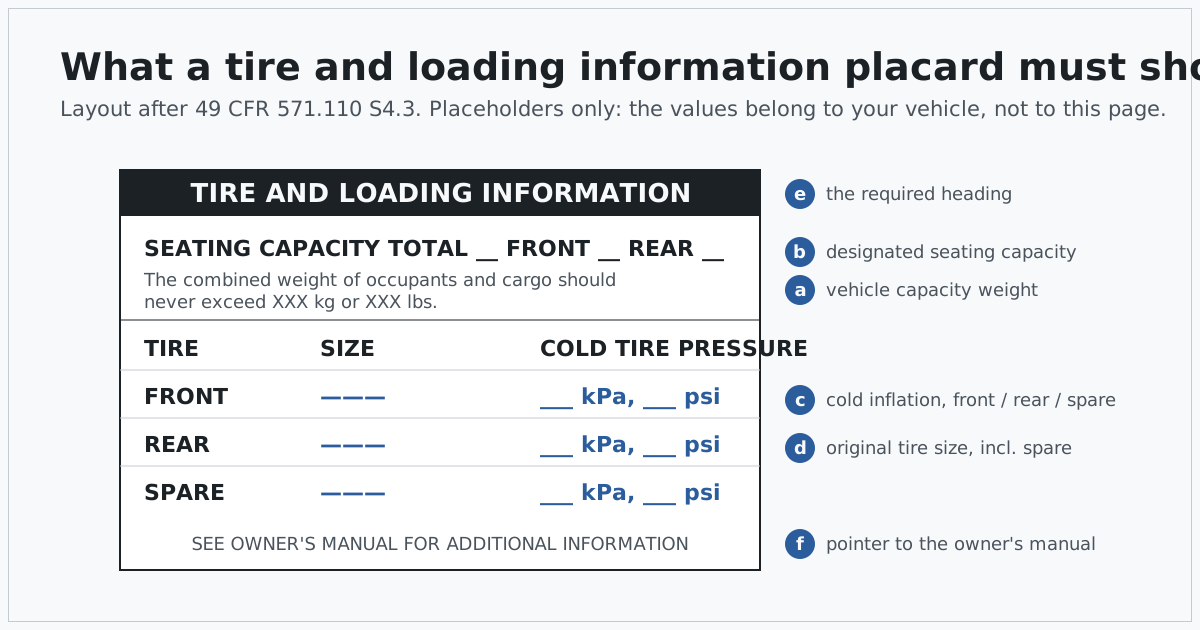
How to read the tire placard comes down to knowing that it is a federally specified label with a fixed layout, and that every line on it is set by the vehicle manufacturer for that vehicle. It tells you how many people the vehicle seats, how much people and cargo together may weigh, the original tire size front, rear and spare, and the cold inflation pressure for each. This guide goes through the placard line by line, using the requirements in Federal Motor Vehicle Safety Standard No. 110, and explains how it relates to what is moulded on the tire.
The values on the placard belong to your vehicle, and none is printed here. The hero drawing uses placeholders for every number, which is the point: the placard is the authority, not this page.
Where the placard is
FMVSS No. 110, at paragraph S4.3, requires the placard to be permanently affixed to the driver's side B-pillar, the upright between the front and rear doors. It sets out fallbacks in order for vehicles where that is not possible:
| Order | Location |
|---|---|
| 1 | Driver's side B-pillar |
| 2 | Forward edge of the rear side door, if there is no B-pillar and the two driver-side doors open in opposite directions |
| 3 | Rear edge of the driver's door |
| 4 | Inward-facing surface next to the driver's seat |
The standard also requires the text to be in English and to follow the format in its Figure 1. In practice, open the driver's door and look at the pillar or the door edge.
On older vehicles the label can be elsewhere. Tire Rack's inflation pressure page notes that placards on vehicles from 1968 to 2003 may be on the driver's door or door jamb, the fuel filler door, the glove box or console, or in the engine compartment, and that the owner's manual often lists the recommended pressures too. NHTSA's tire safety brochure lists the door edge, door post, glove-box door and inside of the trunk lid as places where tire information labels are attached.
The six required items
Paragraph S4.3 lists what the placard must show. The hero drawing keys each to its letter.
| S4.3 item | What appears | What it means |
|---|---|---|
| (a) | "The combined weight of occupants and cargo should never exceed XXX kilograms or XXX pounds." | The vehicle capacity weight |
| (b) | Seating capacity: total, front and rear | Designated seating positions |
| (c) | Cold tire pressure: front, rear, spare | The manufacturer's recommended inflation |
| (d) | Tire size: front, rear, spare | The original tire size designation |
| (e) | "Tire and Loading Information" | The required heading |
| (f) | "See Owner's Manual for Additional Information" | A pointer to the manual |
There is a seventh item, (g), for vehicles with a non-pneumatic spare, which must show that tire's identification code. Paragraphs (h) and (i) allow, but do not require, extra information including a barcode, and the load range, load index and speed rating of the tires.
The sections below take the items in the order you need them.
Cold tire pressure: the number most people come for
Item (c) is the recommended cold tire inflation pressure for the front, rear and spare tires. Where the spare is a full-size tire with the same pressure, the standard allows "see above"; where there is no spare, "none".
Three things make this line easy to misread.
It is the vehicle maker's number, not the tire maker's. NHTSA's brochure states that the vehicle manufacturer, not the tire manufacturer, determines the correct tire pressure for your vehicle. Tire Rack's page says the same: the correct pressure is the one on the vehicle's tire information placard.
It is a cold pressure. NHTSA defines cold as not having been driven for at least three hours, and is explicit that cold does not relate to the outside temperature. After a drive, pressure rises. NHTSA's guidance is that if a tire seems underinflated after driving, you fill it to the recommended cold pressure, and recheck it when cold.
Front and rear can differ. The placard has separate lines because some vehicles specify different pressures front and rear. If yours does, the difference is deliberate, and a plus-size fitment guide from Modern Tire Dealer advises keeping the same relative difference if pressures change.
NHTSA's tire safety page asks for the pressure of all tires, including the spare, to be checked at least once a month when cold. Tire Rack adds that pressure cannot be judged by sight and must be checked with a gauge.
The pressure on the sidewall is a ceiling
The tire carries its own pressure figure, moulded near the bead, and it is the most common source of over-inflation. NHTSA's brochure describes it as the maximum permissible inflation pressure: the greatest amount of air pressure that should ever be put in the tire under normal driving conditions. Tire Rack's page notes that most vehicle manufacturers recommend pressures below that maximum.
| Figure | Where | Set by | What it is |
|---|---|---|---|
| Recommended cold pressure | Placard | Vehicle manufacturer | What to inflate to |
| Maximum pressure | Tire sidewall | Tire manufacturer | What never to exceed |
If the two numbers are the same, it is a coincidence of that tire and vehicle, not a rule. Inflate to the placard.
Vehicle capacity weight: the payload sentence
Item (a) is the sentence that tells you how much people and cargo together may weigh: "The combined weight of occupants and cargo should never exceed XXX kilograms or XXX pounds." FMVSS No. 110 defines this figure, the vehicle capacity weight, as the rated cargo and luggage load plus 68 kilograms times the vehicle's designated seating capacity.
That definition explains how to use the number. It already allows 68 kg per seat. Fill every seat with people heavier than that and the cargo you can carry goes down; carry fewer people and it goes up. Everything inside the vehicle counts against the same total: passengers, luggage, tools, a roof box and what is in it. Tire Rack's page gives the example of a five-passenger SUV that could easily exceed its weight capacity with extra passengers and a loaded rooftop carrier.
Work it as one subtraction:
cargo you can still add = capacity weight − weight of everyone on board
With placeholder figures, a placard stating 1,000 lb and four occupants weighing 170, 160, 140 and 120 lb leaves 410 lb for cargo. The arithmetic is trivial; the point is that the placard figure is a total budget, not a cargo-only number.
Exceeding it overloads the tires. NHTSA's tire page lists overloading, alongside underinflation, as a cause of irregular wear and damage.
Seating capacity
Item (b) gives the designated seating capacity: the total, and how many in front and in the rear. It is used inside item (a), because each designated seat carries a 68 kg allowance in the capacity weight. It is also the number of people the vehicle is designed to carry, which is why the placard states it next to the weight limit.
Original tire size, front, rear and spare
Item (d) gives the tire size designation under the heading "size", "original tire size" or "original size", and the spare under "spare tire" or "spare". As with pressure, a full-size spare can be shown as "see above" and a vehicle with no spare as "none".
This is the size the vehicle was certified with, and it is the reference for every size-change calculation. The size moulded on the tires currently fitted tells you what is on the car, which may not be what the manufacturer specified. NHTSA's brochure advises buying replacement tires that are the same size as the original tires or another size recommended by the manufacturer.
The tire size meaning guide explains each field of the size code. If the front and rear lines show different sizes, the vehicle was certified with different sizes on each axle, and the two are not interchangeable. A temporary spare can be a different size and need a different pressure from the road tires, which is why it has its own line.
What the placard does not show
The placard is short by design. It does not give:
- The load index or speed rating. Item (h) allows them, but they are optional. The load index the vehicle needs is set by its axle loads; the load index vs load range guide explains the scale and the per-axle requirement.
- Axle weight ratings. The gross vehicle weight rating and gross axle weight ratings are on the separate certification label, which FMVSS No. 110 at S4.3.3 also requires to show the rim size designation after each axle rating.
- Wheel specifications. Bolt pattern, centre bore and offset are not on the placard. They are measured on the vehicle, as the bolt pattern guide and centre bore guide explain.
- Alternative sizes. Some owner's manuals list optional sizes; the placard lists the original.
How the placard relates to the rims
FMVSS No. 110 also governs the wheels the vehicle was certified on. Paragraph S4.4.1 requires each rim to be constructed to the dimensions of a rim listed by the tire manufacturer as suitable for use with those tires. Paragraph S4.4.2 requires each rim to be marked with a source designation, the rim size designation, the DOT symbol, the manufacturer's identifier and the date of manufacture.
That is why a tire size and a rim size come as a pair. A different tire size may call for a different approved rim width, which is the tire manufacturer's published figure and is not derivable from the size code; the plus-sizing guide covers how that constrains a size change.
Checking your tires against the placard, step by step
Reading the placard is only useful if you compare it with the tires. The routine takes a few minutes with a pressure gauge:
- Read the placard first, with the vehicle parked and cold. Note the front, rear and spare sizes and the front, rear and spare pressures, and whether any line says "see above" or "none".
- Read the size on each tire, including the spare. Every road tire should match the placard size for its axle. A mismatch is not automatically wrong, but it means the placard pressure was set for a different tire.
- Measure each tire's pressure cold with a gauge, and compare it with the placard figure for that axle, not with the sidewall maximum.
- Adjust to the placard figure. Add air to reach it; if a tire reads high when cold, let air out to reach it.
- Do not forget the spare. NHTSA's monthly check includes it, and a spare that has lost pressure is no use when you need it.
- Recheck after loading heavily if the owner's manual gives a higher pressure for a loaded vehicle. The placard states the baseline; the manual, which item (f) points you to, can carry more detail.
If the sizes match and the pressures match, the tires are being run the way the vehicle was certified. If the sizes do not match, the rest of this guide explains what changed and where to check it.
Using the placard with a size change
When a different size is being considered, the placard gives you the reference size and the reference pressure. The tire size calculator takes the placard size as the current size and the proposed size as the new one, and prints the diameter change, the speedometer error and a to-scale drawing of both. A change in diameter moves the speedometer by the same ratio, as speedometer error from tire size shows.
The placard pressure applies to the original size. A different size, or a move from a standard-load to an extra-load tire, can call for a different pressure to carry the same load, which is a load-inflation question for the tire maker's tables rather than for the placard. Knowing how to read the tire placard is what tells you which figures are fixed by the vehicle and which ones a size change puts back in question.
Sources
- Cornell LII, 49 CFR 571.110 (FMVSS No. 110) — placard location (S4.3), required content (a) to (g), optional content (h) and (i), definition of vehicle capacity weight, certification label rim designation (S4.3.3), rim requirements (S4.4). Retrieved 2026-10-17.
- NHTSA, Tire Safety: Everything Rides On It — label locations, cold pressure definition, vehicle maker sets the pressure, sidewall maximum pressure, replacement size advice. Retrieved 2026-10-17.
- NHTSA, Tire Safety Ratings and Awareness — monthly checks including the spare; overloading as a cause of damage. Retrieved 2026-10-17.
- Tire Rack, How Do I Check Tire Air Inflation Pressure? — placard location before and after 2003, sidewall pressure is a maximum, loaded SUV example, use a gauge. Retrieved 2026-10-17.
- Modern Tire Dealer, Tire/wheel plus-sizing: Changing the look also changes the performance — keep the front-to-rear pressure difference. Retrieved 2026-10-17.
- The cargo arithmetic uses placeholder figures, not any vehicle's values.
Frequently asked questions
Where is the tire placard on a car?
On vehicles covered by FMVSS No. 110, the placard is permanently affixed to the driver's side B-pillar. If there is no B-pillar, the standard moves it to the forward edge of the rear side door, then the rear edge of the driver's door, then the inward-facing surface next to the driver's seat. Tire Rack notes that before 2003 placards could also be on the fuel filler door, the glove box, the console or in the engine compartment.
Should I inflate my tires to the pressure on the placard or on the tire?
The placard. NHTSA states that the vehicle manufacturer, not the tire manufacturer, determines the correct tire pressure for the vehicle. The figure moulded on the tire sidewall is the maximum permissible inflation pressure, the most the tire should ever hold, not a recommendation.
What does 'cold' tire pressure mean?
NHTSA defines a tire as cold when the vehicle has not been driven for at least three hours. It has nothing to do with the outside temperature. The placard's pressures are cold pressures, so a reading taken after a drive will be higher and should not be let down to match.
What does 'combined weight of occupants and cargo should never exceed' mean?
It is the vehicle capacity weight, which FMVSS No. 110 defines as the rated cargo and luggage load plus 68 kilograms times the designated seating capacity. It is the most that people and cargo together should weigh. Every passenger and every item you load counts against the same figure.
What if the tires on my car do not match the placard size?
Then the tires are not the original size, and the placard is the reference for what the vehicle was certified with. NHTSA advises buying replacement tires that are the same size as the vehicle's original tires or another size the manufacturer recommends. If a different size is fitted, the tire size calculator shows how far its diameter is from the placard size.