Guides /
Speedometer Error From Tire Size, Worked Out
Speedometer error from tire size is one ratio, new diameter over old. Worked examples, an error table from 20 to 80 mph, odometer drift and a timing check.
Speedometer error from tire size comes down to one ratio: the overall diameter of the tire you fitted divided by the overall diameter of the tire the speedometer was set up for. The instrument counts wheel revolutions and multiplies by a fixed distance per revolution. Change the tire and that distance changes, but the instrument keeps using the old one. This guide works the ratio through real size codes, shows why the error in mph grows with speed while the percentage stays put, and covers what the odometer, a phone and a stopwatch can tell you.
No vehicle is named here. The size your speedometer was calibrated for is the original size on your Tire and Loading Information placard, and the guide to reading that placard shows where to find it. Everything below works from the size codes themselves.
Why a speedometer depends on tire size
Tire Rack's speedometer accuracy page puts the mechanism plainly: most vehicles' speedometers measure speed based on tire revolutions. A sensor somewhere in the driveline counts rotations, and the instrument converts rotations per second into road speed using a distance per rotation it was programmed with. That distance is the rolling circumference of the original tire.
The instrument has no way of knowing the tire changed. If the new tire is taller, each revolution covers more road than the instrument assumes, so the car is moving faster than the needle says. If the new tire is shorter, the reverse. Tire Rack's shorthand for this is "Taller = Slower, Shorter = Faster": taller tires make the speedometer read slower than you are going, shorter tires make it read faster.
Because circumference is π times diameter, and π cancels out of any comparison, the whole correction collapses to a single ratio:
true speed = indicated speed × (new diameter ÷ old diameter)
speedometer error, % = (new diameter ÷ old diameter − 1) × 100
That is the entire model. Everything else on this page is that formula applied to particular sizes, plus the reasons a real tire departs a little from it.
Working the ratio for three size changes
Take 225/65R17 as the size the speedometer was set up for, and three sizes someone might fit in its place: one 10 mm wider, one 20 mm wider, and one with a lower aspect ratio. The diameters come straight from the codes, using the formulas in the tire size meaning guide.
| Size | Overall diameter | Change | Revs per mile | True speed at 60 indicated |
|---|---|---|---|---|
| 225/65R17 (reference) | 724.3 mm | none | 707.3 | 60.0 mph |
| 235/65R17 | 737.3 mm | +1.79% | 694.8 | 61.1 mph |
| 245/65R17 | 750.3 mm | +3.59% | 682.8 | 62.2 mph |
| 225/60R17 | 701.8 mm | -3.11% | 729.9 | 58.1 mph |
Two things stand out. First, a width change alone moves the speedometer. Going from 225 to 235 at the same 65 aspect ratio adds 6.5 mm to each sidewall, because the sidewall is 65% of the width, and the diameter grows by twice that. People who only meant to fit a slightly wider tire are often surprised that they also changed their speedometer reading.
Second, the revolutions-per-mile column is the number the instrument actually responds to. The 245/65R17 turns 24.5 fewer times per mile than the reference. The speedometer sees fewer revolutions in each second and reports a lower speed, even though the car is covering the same road.
Speedometer error chart from 20 to 80 mph
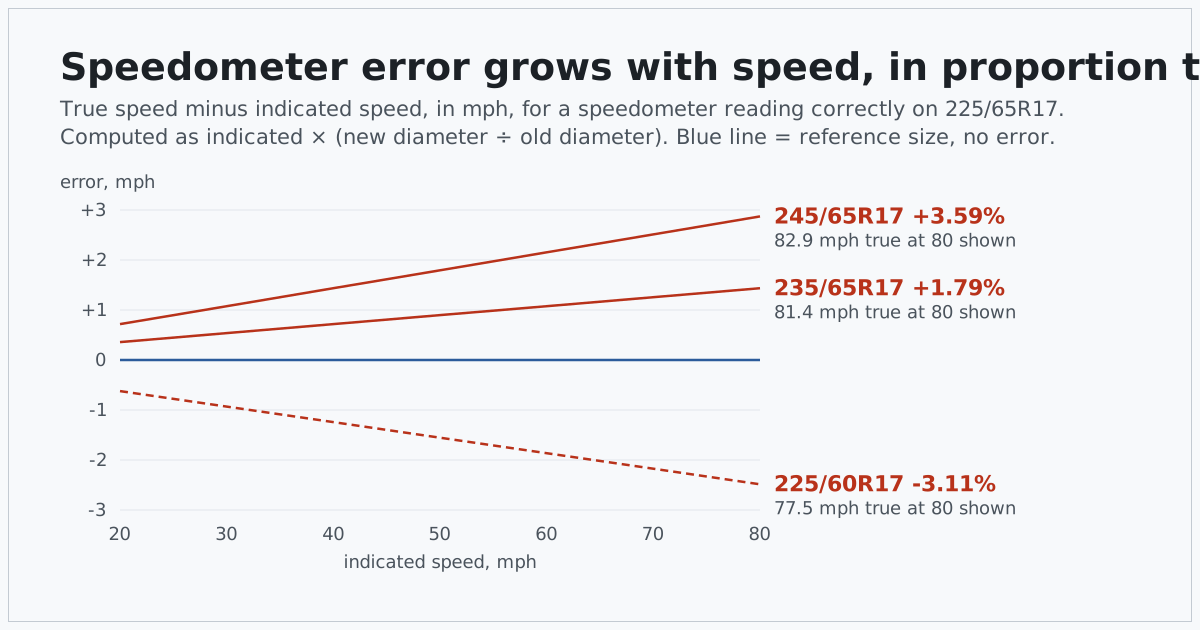
The percentage error is fixed for a given pair of sizes. The error in mph is not: it scales with speed, because it is a percentage of whatever speed you are doing. That is why a change that seems trivial around town matters on a highway.
| Indicated | 235/65R17 true | 245/65R17 true | 225/60R17 true |
|---|---|---|---|
| 20 mph | 20.4 (+0.4) | 20.7 (+0.7) | 19.4 (-0.6) |
| 30 mph | 30.5 (+0.5) | 31.1 (+1.1) | 29.1 (-0.9) |
| 40 mph | 40.7 (+0.7) | 41.4 (+1.4) | 38.8 (-1.2) |
| 50 mph | 50.9 (+0.9) | 51.8 (+1.8) | 48.4 (-1.6) |
| 60 mph | 61.1 (+1.1) | 62.2 (+2.2) | 58.1 (-1.9) |
| 70 mph | 71.3 (+1.3) | 72.5 (+2.5) | 67.8 (-2.2) |
| 80 mph | 81.4 (+1.4) | 82.9 (+2.9) | 77.5 (-2.5) |
All three columns are relative to a speedometer that reads exactly right on 225/65R17. Read across any row and the pattern holds: the taller sizes put you above the indicated speed, the shorter size below it, and every gap is wider at 80 than at 20.
The chart in the header draws the same numbers as lines. They fan out from zero because error in mph is a straight-line function of speed with no constant term. There is no speed at which a diameter change stops mattering; it just matters less at walking pace.
Taller reads slow, shorter reads fast: which matters more
The two directions of error have different consequences, and it is worth being clear which is which.
A taller tire makes the speedometer under-read. You are going faster than the instrument shows. If you hold an indicated 70 on 245/65R17 in place of 225/65R17, you are doing about 72.5 mph. Speed limits are enforced against the speed you are doing, not the speed you were shown, so this is the direction that catches people out.
A shorter tire makes the speedometer over-read. You are going slower than the instrument shows. That is less likely to get you a ticket, but the odometer now runs fast, which matters for anything measured in miles: service intervals, warranty limits, lease mileage, and the resale record of the car.
Nothing here assumes the instrument was exact on its original tires. The ratio tells you how much the tire change moves the reading relative to wherever it was before.
Odometer error and fuel economy
The odometer counts the same revolutions the speedometer does, so it carries the same ratio. Fit a taller tire and the odometer records fewer miles than the car covers; fit a shorter one and it records more.
| Size fitted | Odometer shows | Car actually covered | Difference |
|---|---|---|---|
| 235/65R17 | 100.0 mi | 101.8 mi | +1.8 mi |
| 245/65R17 | 100.0 mi | 103.6 mi | +3.6 mi |
| 225/60R17 | 100.0 mi | 96.9 mi | -3.1 mi |
Fuel economy calculated from the odometer inherits the error. If you divide odometer miles by gallons, a taller tire makes the result read low by the same proportion, because the true distance was longer than recorded. Multiply the calculated figure by the diameter ratio to correct it. A change in measured mpg after a tire change is often this arithmetic, not a change in the engine.
Where a trip computer or range estimate works from the same revolution count, it moves in the same direction. None of this changes how far the car actually goes on a tank; it changes what the instruments say about it.
Nominal dimensions, wear and the limits of the formula
Every diameter on this page is nominal: computed from the size code, not measured on a tire. Tire Rack's tire dimensions page is explicit that these calculations, and those from every online tire dimension calculator, only reflect nominal tire dimensions, and that actual sizes vary between manufacturers. The same page gives a rule of thumb that section width changes by about 0.2 inch for every 0.5 inch change in rim width, which is a reminder that the mounted tire depends on the wheel too.
Three effects separate the formula from the road:
- Brand and model. Two tires with the same size code from different makers can differ slightly in diameter. The code is a nominal designation, not a manufacturing tolerance.
- Load and pressure. A tire under load flattens at the contact patch, so its rolling radius is less than half its unloaded diameter. Because the reference tire also flattened, the ratio between two sizes is affected far less than either absolute figure.
- Tread wear. Tread is part of the radius, so a worn tire is smaller than a new one of the same size. A speedometer that reads one way on new tires can read a little differently on worn ones, with no size change at all.
None of these makes the ratio wrong. They make it nominal, which is why this site rounds speeds to one decimal and does not claim more precision than the size code carries.
How much error is acceptable
There is no single number that applies to every vehicle, and it is worth knowing which numbers exist and what they cover.
The one federal figure that is easy to point to is narrow in scope. 49 CFR 393.82, part of the federal motor carrier safety regulations, requires each bus, truck and truck-tractor it covers to have a speedometer accurate to within plus or minus 5 mph at 50 mph. That is a rule for commercial vehicles, and it is a tolerance for the whole instrument, not an allowance for tire changes.
For tire size changes the trade works to a rule of thumb. Modern Tire Dealer's plus-sizing article says a diameter variance of 2% to 3% or less is widely accepted as posing no adverse effects on vehicle systems, and the tire size calculator flags anything beyond ±3% for the same reason. The methodology page is explicit that ±3% is a convention, not a standard.
Put that convention into speed terms and it is a band of ±2.4 mph at an indicated 80. Of the three sizes above, 235/65R17 sits inside it at +1.79%, while 245/65R17 at +3.59% and 225/60R17 at -3.11% both fall just outside. The speedometer is the visible symptom; the same ratio also reaches anti-lock braking, traction and stability control, which Tire Rack's plus-size page names alongside the speedometer as the systems a large diameter change can affect, and it changes effective driveline gearing. That is the reason the trade cares about diameter in the first place.
Checking your own speedometer with a stopwatch
The ratio tells you how much a tire change moved the reading. It does not tell you where the reading started. To find out how your speedometer reads now, on the tires you have, Tire Rack describes a timing method: a passenger times how long the car takes to cover one measured mile at a steady indicated speed on an open highway, the test is repeated at least three times, and the results are averaged.
The conversion is exact arithmetic, because an hour is 3,600 seconds:
true speed, mph = 3,600 ÷ seconds to cover one mile
| Seconds for one mile | True speed |
|---|---|
| 57 | 63.2 mph |
| 58 | 62.1 mph |
| 59 | 61.0 mph |
| 60 | 60.0 mph |
| 61 | 59.0 mph |
| 62 | 58.1 mph |
| 63 | 57.1 mph |
If you hold an indicated 60 and the mile takes 58 seconds, you were doing about 62.1 mph, and the speedometer under-reads by about 3.4%. One second either way at this speed is worth roughly a mile an hour, which is why averaging several runs matters: a single run with a late stopwatch press is enough to swamp the effect you are trying to measure.
A phone's satellite speed is a useful second opinion at a steady speed on a straight road. It measures position over time and knows nothing about your tires, so it is independent of the error you are checking. It is less reliable when accelerating, in tunnels or between tall buildings.
Recalibrating after a size change
Tire Rack's advice is that recalibration of your speedometer is recommended if a significant inaccuracy is noted. How that is done depends entirely on the vehicle, and the procedure for a particular make and model is vehicle data that this site does not publish. A dealer or a specialist who works on your vehicle is the place to ask.
What the arithmetic can do is tell you the number to recalibrate to. The new tire's revolutions per mile, or its rolling circumference, is the figure the instrument needs, and the correction factor is the diameter ratio above.
The tire size calculator prints all of this for any pair of sizes you type: both diameters, the percentage change, revolutions per mile and a speedometer table from 20 to 80 mph, with a to-scale cross-section of the two tires. If a size you are considering lands outside ±3%, the plus-sizing guide shows how to choose a combination that keeps the diameter close. Either way, the answer to speedometer error from tire size is the same ratio every time: new diameter over old.
Sources
- Tire Rack, How Do I Check Speedometer Accuracy? — speedometers measure speed from tire revolutions; taller reads slower, shorter reads faster; the measured-mile timing method and recalibration advice. Retrieved 2026-10-17.
- Tire Rack, How Do I Calculate Tire Dimensions? — calculated dimensions are nominal; the 0.2 inch per 0.5 inch rim width rule of thumb. Retrieved 2026-10-17.
- eCFR, 49 CFR 393.82 Speedometer — plus or minus 5 mph at 50 mph for covered buses, trucks and truck-tractors. Retrieved 2026-10-17.
- Tire Rack, What Are Plus Size Wheels & Tires? — large diameter changes can affect speedometer accuracy, ABS, traction control and stability systems. Retrieved 2026-10-17.
- Modern Tire Dealer, The ABCs of Plus Sizing — 2% to 3% diameter variance widely accepted. Retrieved 2026-10-17.
- All diameters, revolutions per mile and speed figures on this page are computed from the size codes shown, using the formulas on the methodology page.
Frequently asked questions
Does a bigger tire make the speedometer read higher or lower?
Lower. A taller tire covers more road per revolution, but the speedometer still assumes the old, shorter distance, so it under-reads. With 235/65R17 fitted where the speedometer was set up for 225/65R17, an indicated 60 mph is about 61.1 mph on the road. A shorter tire does the opposite and over-reads.
Is speedometer error the same percentage at every speed?
Yes. The error is a fixed ratio of the two diameters, so the percentage never changes. What changes is the error in mph, which grows in proportion to speed. A 1.79% diameter increase is about 0.5 mph at 30 indicated and about 1.4 mph at 80 indicated.
Does the odometer have the same error as the speedometer?
Yes, and in the same direction, because both are counting the same wheel revolutions. A tire 1.79% taller in diameter makes the odometer record about 1.76% fewer miles than the car actually covers, which also makes a fuel economy figure calculated from the odometer read low by the same proportion.
How do I check my speedometer without special equipment?
Tire Rack's method is to have a passenger time one measured mile at a steady indicated speed on an open highway, repeat it at least three times and average the results. True speed in mph is 3,600 divided by the seconds the mile took, so 60 seconds is exactly 60 mph and 58 seconds is about 62.1 mph.
How much speedometer error is legal?
For buses, trucks and truck-tractors covered by the federal motor carrier safety regulations, 49 CFR 393.82 requires the speedometer to be accurate to within plus or minus 5 mph at 50 mph. That rule is specific to those vehicles. For a passenger car, the practical limit is the speed you are actually driving, which is what a speed limit is enforced against regardless of what the instrument showed.